



 27 / 308

27
The History of the Department
The Department in a Field of Tension
‘It’s a difficult relationship, the industrial sector and higher
education, time and time again.’ (Prof. Hajek) – ‘Applied
research and basic research don’t always have to con-
tradict each other.’ (Prof. Lienkamp) – ‘We have to accept
political decisions.’ (Prof. Adams).
It is not just questions of research, external funds and
higher education bureaucracy that the faculty is con-
cerned with. There are also major issues of responsibility,
freedom and the benefits of science. How is research
funded? Who makes decisions about issues and the
subjects of research? What influence do social develop-
ments or political decisions have on science? Conflicting
concepts soon emerge: contract research versus free
research; fundamental research versus application-ori-
ented research; research trends versus research tradition.
These questions are not new; they have been the subject
of discussion in the sciences, at TUM and in the depart-
ment for generations.
Here we take a look back at the history of the department,
and through exemplary stories show how former gener-
ations answered these questions. The different ways in
which these issues are currently being tackled will then be
outlined on the basis of interviews with five professors.
The Founding of the Department
The industrialisation of continental Europe began in the
early years of the 19th century. In Bavaria, too, factories
sprang up with industrial production methods, and from
1835, the railway followed, with the first line travelling
between Nuremberg and Fürth. A short time later, the first
Bavarian shipping company was founded and canal con-
struction was driven forward. Industrial companies were
established such as the locomotive factory J.A. Maffei or
the Sander’sche Maschinenfabrik und Eisengießerei, the
Sander machine works and iron casting company and the
Maschinenfabrik Klett & Comp. machine works, both of
which were the forerunners of MAN. During the second
half of the 19th century, Bavaria experienced a veritable
wave of industrialisation.
At the same time, from 1805, political visions were being
created; Bavaria became a kingdom. It was a political goal
of the Bavarian kings to promote technology in Bavaria.
In particular, the territorial gains of Franconia – linen
production in Upper Franconia – and Augsburg – the
textile industry – played an important role. Additionally,
the example of Paris awakened a desire for more, with its
École Polytéchnique, which had been in existence since
1794. The first attempt in Bavaria had already failed after
six years. In 1833, the ‘Polytechnische Centralschule’
closed its doors again. From then on, technical training in
Munich focussed on architecture. Instead, polytechnics
opened in Nuremberg and Augsburg, with a focus on
the main areas of scientific interest of their respective
locations. In Nuremberg, these were the casting and metal
works, while in Augsburg, wool and cotton manufacture.
In Munich, a ‘Faculty for Higher Technical Officers’ was
established at the University of Munich, with archi-
tecture and the preservation of historical monuments
being retained as the field of study. In 1848, Maximilian
II, the third Bavarian king, took over the government.
He promoted commerce and the industrial sector and
founded the State Ministry of Trade and Public Works,
the precursor to today’s Ministry of Economic Affairs.
Ludwig II, who occupied the Bavarian throne after 1864,
made a second attempt in 1868 and founded the Munich
Polytechnic School. Department IV of the School, the
Mechanical-Technical Department, is where life began for
today’s Department of Mechanical Engineering. There,
knowledge about fundamental mechanical principles was
to be gathered, expanded and disseminated. Specialists
were to be trained with a specific technical perspective
on the world. Both on the part of the state, whose political
will to design technology had intensified, as well as of the
industrial sector, which was rapidly prospering, demand
for these specialists was increasing. Against this political
and economic background, the second attempt at found-
ing a technical training facility was a success.
Science – Politics – Industry
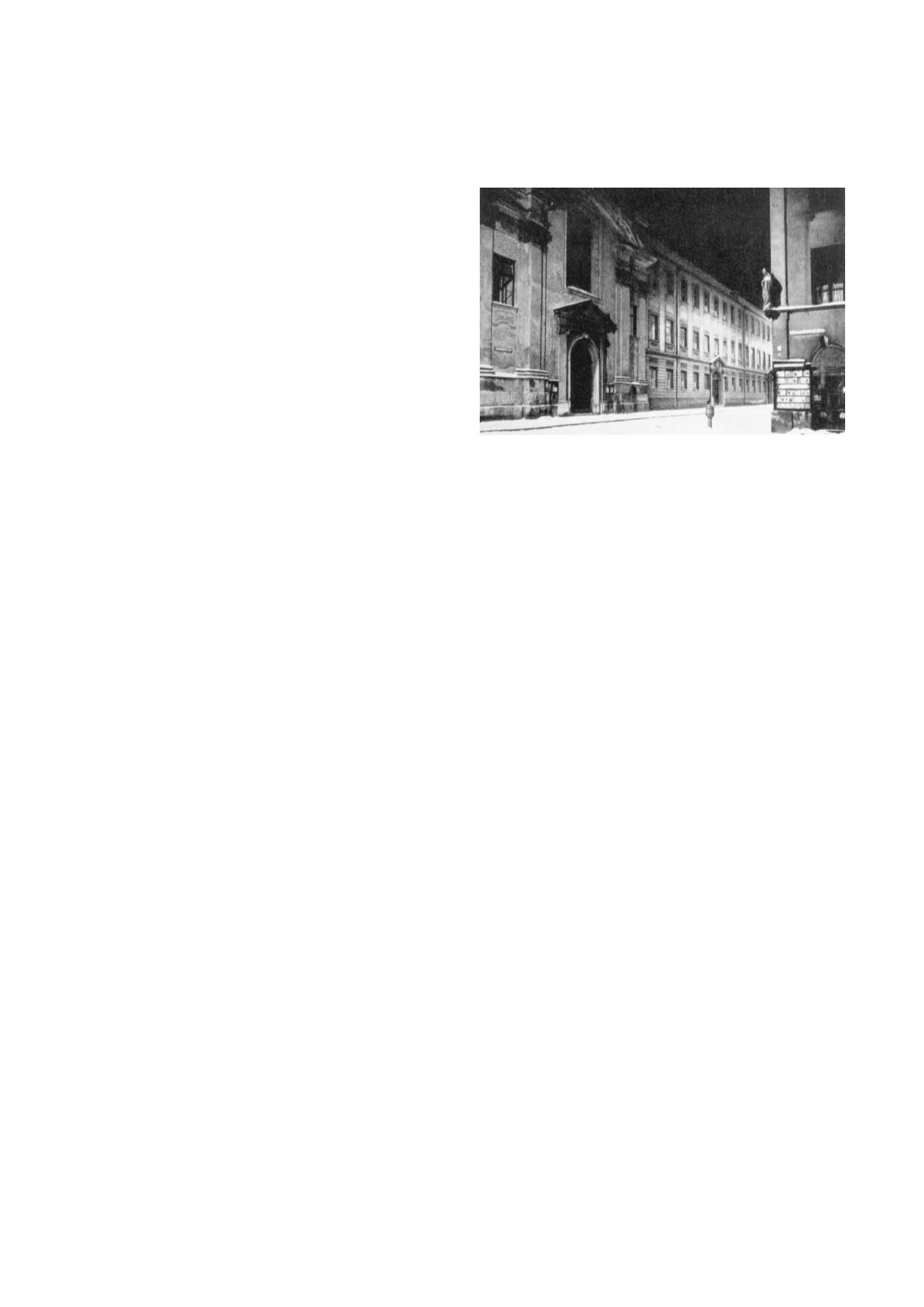
The Munich Polytechnic School in the Damenstiftstrasse, founded in 1827