



 28 / 308

28
The History of the Department
Contract Research vs. Free Research
1871
Laboratories Working on Behalf
of the Industrial Sector
In 1871, Johann Bauschinger founded the Mechanical-
Technical Laboratory. Today, it is known as the State
Material Material Testing Agency for Mechanical Engineer-
ing (Staatliche Materialprüfamt für den Maschinenbau;
MPA), which regards itself as a service provider for the
industrial sector. Bauschinger’s original plan envisaged
something different. From his perspective, the laboratory
was intended above all to promote mechanical engineer-
ing research. It was only gradually that it began to be used
differently. The original additional objective of inspecting
materials and construction parts in exchange for money
increasingly replaced the research activity.
A similar development occurred with Carl von Linde’s
Laboratory of Machine Science. While it was also orig-
inally intended as places of research and learning, his
laboratory established in 1875 quickly became a hub for
inspecting and testing industrial products and providing
advice to companies. Moritz Schröter in particular, who
succeeded von Linde in 1879 and who was a distin-
guished expert in the field of technical thermodynamics,
further expanded this main field of activity. The independ-
ent scientific work of the Technical University meant that
industrial products obtained a type of quality seal after
they had been inspected. Over the years, this became one
of the department’s most important areas of work.
Almost all publications about theoretical mechanical
engineering were written on behalf of the industrial sector.
Around 80 percent of the articles published by Schröter
were about steam engines and turbine inspections. This
activity was also criticised in specialist circles: Hans
Lorenz, a contemporary of Schröter and Professor for
Mechanical Engineering at the University of Halle, argued
that: ‘Schröter contents himself with publishing extensive
acceptance tests without drawing any notable conclu-
sions from them, which was always the risk entailed by
the impetus from the industrial sector with its commercial
interests.’
As well as testing the functioning of machines, the
mechanical engineering professors also produced assess-
ment reports. These could be presented as evidence in
cases of dispute, technical failure or accidents, or patent
proceedings. Linde stressed that: ‘For the lack of under-
standing among members of the patent office department
in question, there is less to be gained from strictly physical
proof (which they are unfortunately unable to comprehend)
than through a certain explanation regarding the resulting
facts of the case from an authoritative agency.’ Linde was
convinced by the benefits of assessment reports. In a
letter to his teacher, Gustav Zeuner, he wrote that the task
of science was to assist in ensuring that justice prevailed
with the aid of non-partisan judgements. However, in daily
practice, the independent nature of the professors, who
as state officials exuded an aura of non-partisanship, was
considerably limited, as Linde’s example shows.
On Linde’s initiative, in 1887 the Munich Polytechnic
Association built a test station for refrigeration machines,
which was supervised by Schröter. At the test station,
other producers of refrigeration machines were to be given
the opportunity of having the quality of their machines
tested. Since the test station was in effect under Linde’s
control, however, and thus under the control of one of the
owners of the Gesellschaft für Linde’s Eismaschinen AG
(‘Linde’s Ice Machine Company’), other companies did not
trust the independent nature of the test station. During the
station’s five-year existence, only three companies had
their refrigeration machines tested there, apart from those
produced by Linde’s company.
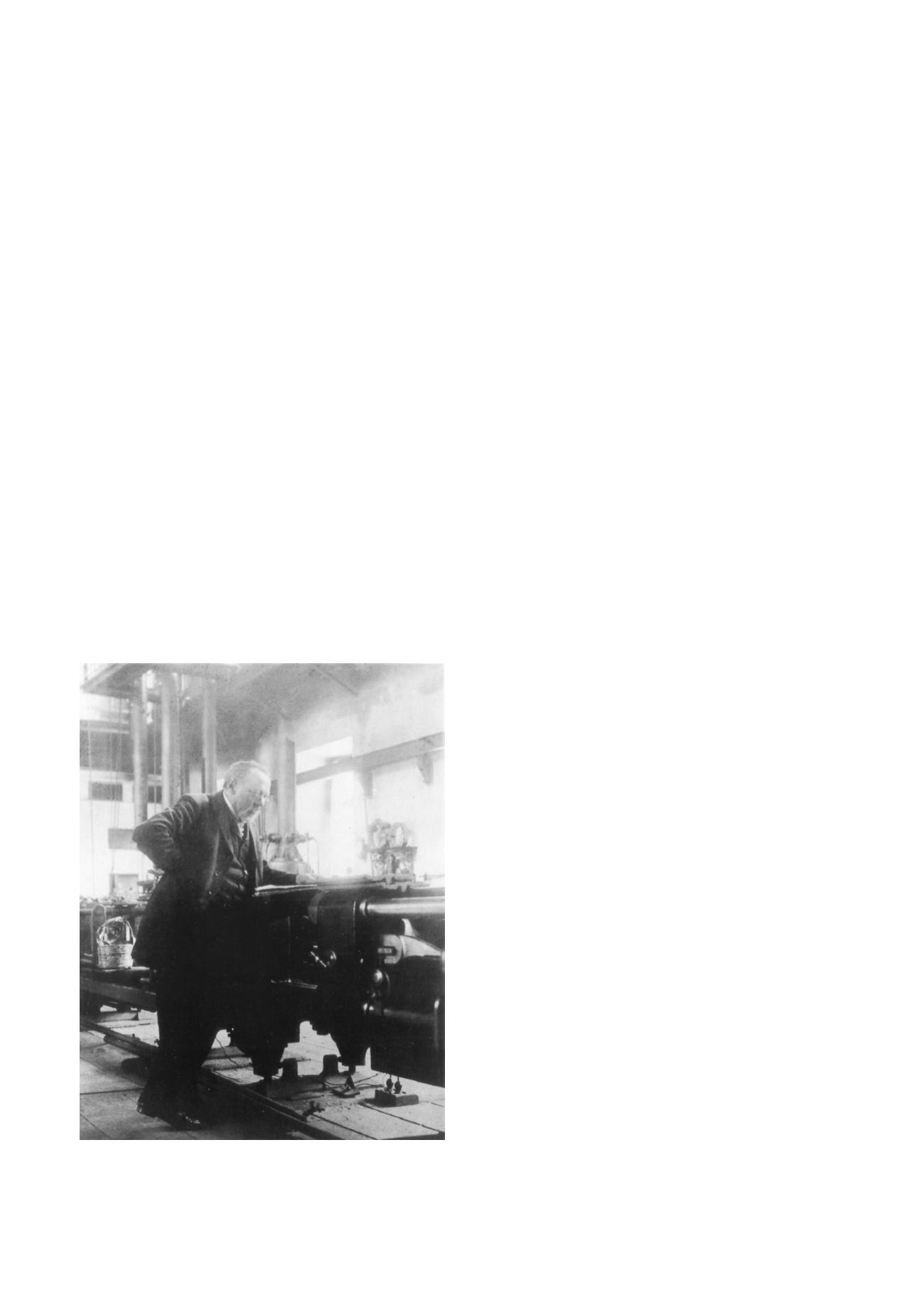
Konrad Klebe, an assistent at the Mechanical-Technical Laboratory from
1871-1911, at the Werder tensile and bending testing machine