




 101 / 308

101
Aerodynamics and Fluid Mechanics
Numerical Methods for Computational Fluid Dynamics
Physical Consistency of High-resolution CFD
Motivation and Objectives
CFD tools in physical or engineering applications can
never reach numerical resolution levels where the
truncation error of the discretization schemes enters its
asymptotic limit. It thus is of high practical relevance to
design schemes that have good scale resolution proper-
ties whenever numerical resolution is sufficient for relevant
flow scales, and whose truncation error functions as a
physically consistent subgrid-scale model when not. In the
past, this research concept has led to the development of
the first physically consistent and practically successful
implicit LES model. Currently, the notion of employing
model uncertainty and truncation errors as physical-model
surrogates is being pursued on several levels.
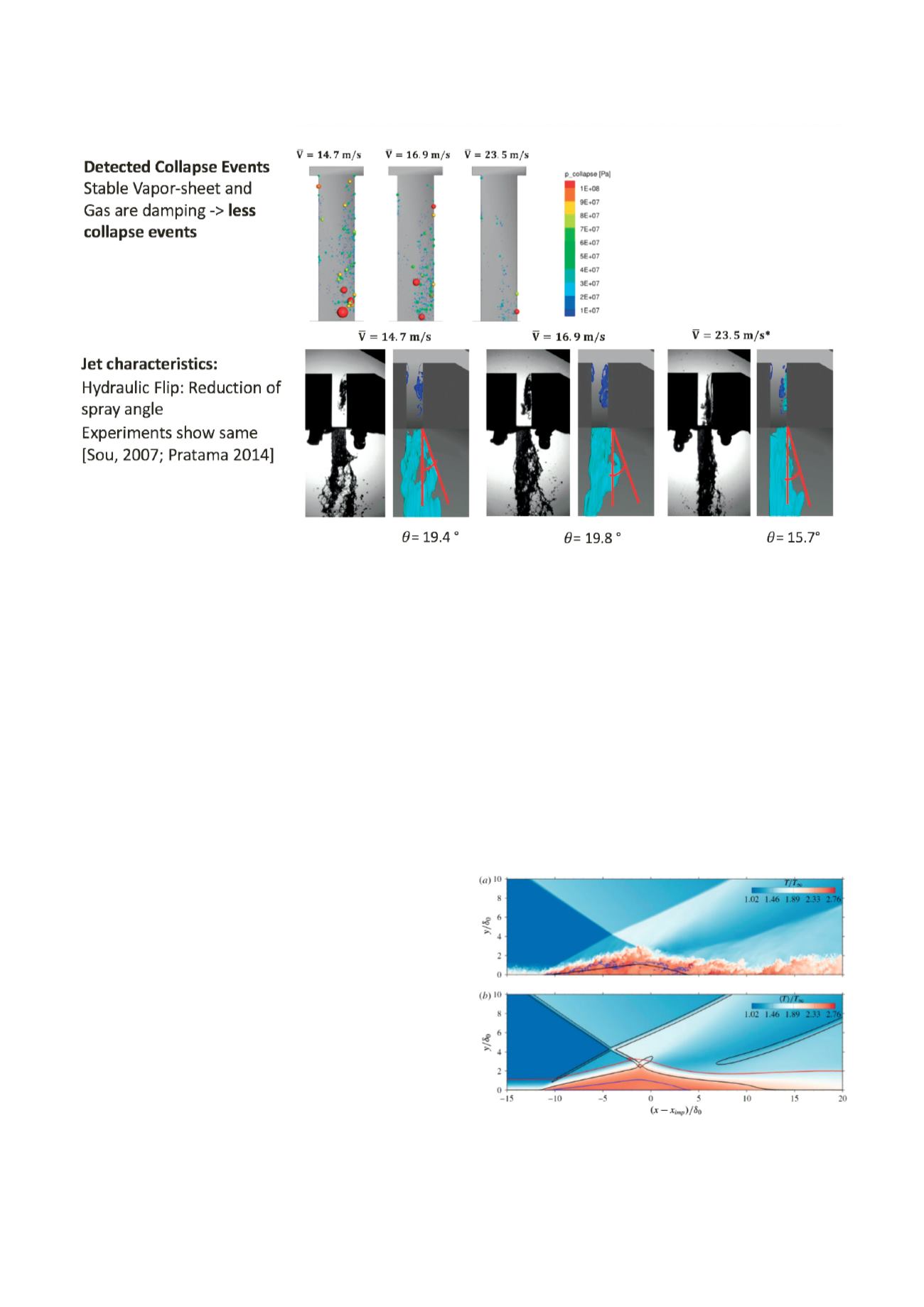
Spray angle and erosion analysis in generic injector components.
Key Results
■■
Budich, B.; Schmidt, S.J.; Adams, N.A.: Numerical
Simulation and Analysis of Condensation Shocks in
Cavitating Flow. To appear in Journal of Fluid Mechan-
ics (accepted 2017)
■■
Beban, B.; Schmidt, S.J.; Adams, N.A.: Numerical
study of submerged cavitating throttle flows. Atomiza-
tion and Sprays (27 (8)), 2017, pp. 723-739
■■
Egerer, C.P.; Schmidt, S.J.; Hickel, S.; Adams, N.A.:
Efficient implicit LES method for the simulation of
turbulent cavitating flows. Journal of Computational
Physics, Volume 316, 2016, pp. 453-469
■■
Örley, F.; Hickel, S.; Schmidt, S.J.; Adams, N.A.:
Large-Eddy Simulation of turbulent, cavitating fuel flow
inside a 9-hole Diesel injector including needle move-
ment. International Journal of Engine Research, 2016,
pp. 1-17
Instantaneous contours of temperature (top) of Ma=3 shock impinging on a
turbulent boundary layer, and corresponding mean flow (bottom)