




 102 / 308

102
Aerodynamics and Fluid Mechanics
Approach to Solution
Concepts of physical design of modeling and discretiza-
tion error have been successfully employed for further
development of high-resolution schemes and targeted
ENO schemes that are suitable for underresolved
computations of turbulent and non-turbulent flows. The
physically consistent implicit LES model ALDM has been
applied to turbulent shock-boundary-layer interaction at
unprecedented Reynolds numbers. Extending the general
concept to numerical models for fluctuating hydrodynam-
ics, the manipulation of modeling errors within the
dissipative-particle-dynamics model is investigated to
explore spontaneous long-range correlations in turbulent
flows. Physical effects of truncation errors in particle-dis-
cretizations may also lead to relaxation processes that
allow for highly effective mesh generation and domain
partitioning methods. Both have been developed to a
pre-commercialization demonstration level.
Key Results
■■
Pasquariello, V.; Hickel, S.; Adams, N.A.: Unsteady
effects of strong shock-wave/boundary-layer interac-
tion at high Reynolds number. Journal of Fluid Mechan-
ics (823), 2017, pp. 617-657 mehr … BibTeX Volltext
(DOI)
■■
Diegelmann, F., Hickel, S., Adams, N.A.: Three-dimen-
sional reacting shock–bubble interaction. Combustion
and Flame 181, 2017, pp. 1339-1351 mehr … BibTeX
Volltext (DOI)
■■
Fu, L.; Hu, X.Y.; Adams, N.A.: Targeted ENO schemes
with tailored resolution property for hyperbolic conser-
vation laws. Journal of Computational Physics (349),
2017, pp. 97-121 mehr … BibTeX Volltext (DOI)
■■
Fu, L.; Hu, X.Y.; Adams, N.A.: A physics-motivated
Centroidal Voronoi Particle domain decomposition
method, Journal of Computational Physics 335, 2017,
pp. 718-735 mehr … BibTeX Volltext ( DOI )
■■
European Patent Application EP32556611, Hu X., Fu L.,
Han L., Adams N.A., Method and system for generating
a mesh
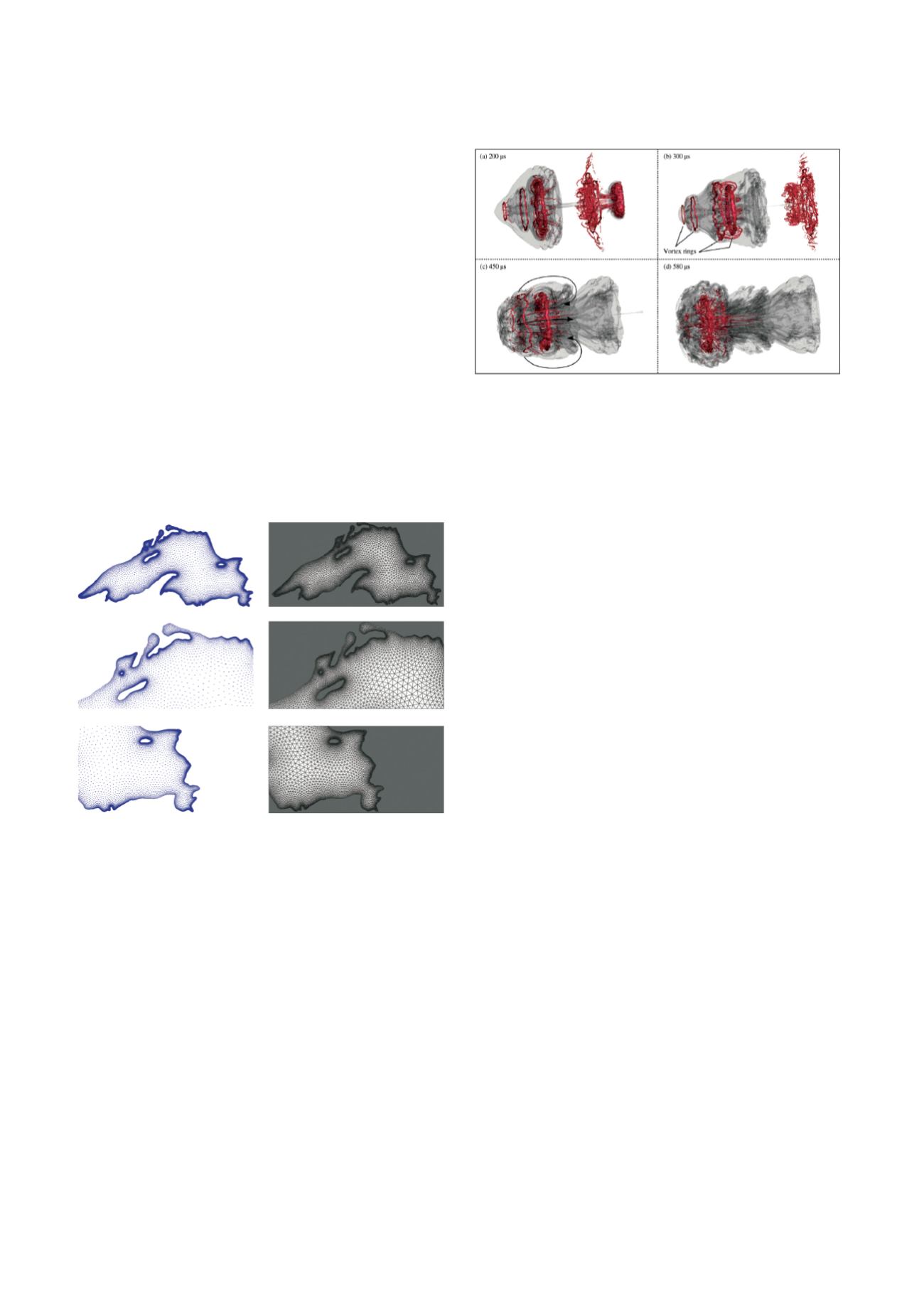
Vortex-ring evolution for reacting shock-bubble interaction, grey shades
correspond to inert-gas mass fraction and red is isosurface of vorticity v
Automatic generation of unstructured meshes with high mesh quality
based on physical-particle advection anaology
Smoothed Particle Hydrodynamics Method for Simulating Free Surface Flow
Motivation and Objectives
Smoothed particle hydrodynamics (SPH) is a purely mesh-
free Lagrangian method developed for astrophysical appli-
cations. Since these pioneering works, the SPH method
has been successfully applied for numerical simulations
of solid mechanics, fluid dynamics and fluid-structure
interaction. Concerning the computation of hydrodynamic
problems, the present methods either lead to violent
pressure oscillations or excessive dissipation and are not
able to reproduce correct physical phenomena reliably.
Approach to Solution
We present a low-dissipation, weakly-compressible SPH
method for modeling free-surface flows exhibiting violent
events such as impact and breaking. The key idea is to
modify a Riemann solver which determines the interaction
between particles by using a simple limiter to decrease
the intrinsic numerical dissipation. The modified Riemann
solver is also extended for imposing wall boundary con-
ditions. Numerical tests show that the method resolves
free-surface flows accurately and produces smooth,
accurate pressure fields.