



 104 / 308

104
Aerodynamics and Fluid Mechanics
Aircraft and Helicopter Aerodynamics
Motivation and Objectives
The long-term research agenda is based on the continued
improvement of flow simulation and analysis capabilities
in the context of aircraft and helicopter performance
enhancement and drag reduction. Specific research
activities are dedicated to the reliable prediction of
flow separation onset and progression in the context of
vortex dominated flow and control of leading edge vortex
systems, development of a novel ROM framework for
aeroelastic analysis, helicopter drag reduction of rotor hub
and engine intake by shape optimization and flow control,
development of propeller performance and optimization
tool chain with respect to electrically driven flight vehicles
and fluid-structure interaction of membrane-type lifting
surfaces applied to wind turbine rotors.
Approach to Solution
The investigations have been performed using both wind
tunnel experiments and state-of-the art numerical simula-
tions. In-house codes are continously elaborated further
in the context of aeroelasticity analysis with respect to
time-accurate, fully-coupled simulations as well as the
application of novel neuro-fuzzy based reduced order
models. Commercial CFD codes are applied to flow
control problems and helicopter aerodynamics addressing
unsteady loads analysis and aeroacoustics.
Key Results
■■
Buzica, A., Bartasevicius, J. and Breitsamter, C.: Exper-
imental investigation of high-incidence delta-wing flow
control. Experiments in Fluids, Vol. 58:131, 2017
■■
Buzica, A. and Breitsamter, C.: Experimental and
Numerical Investigation on Delta-Wing Post-stall Flow
Control. NNFM, Vol. 136, Springer 2017, pp. 167-177
■■
Knoth, F. and Breitsamter, C.: Flow Analysis of a
Helicopter Engine Side Air Intake. Journal of Propulsion
and Power, Vol. 33, No. 5, 2017, pp. 1230-1244
■■
Knoth, F. and Breitsamter, C.: Aerodynamic Charac-
teristics of Helicopter Engine Side Air Intakes. Aircraft
Engineering and Aerospace Technology, 2017
■■
Knoth, F. and Breitsamter, C.: Aerodynamic Testing of
Helicopter Side Intake Retrofit Modifications. Aero-
space, Vol. 4, 33, 2017, pp. 1-17
■■
Knoth, F. and Breitsamter, C.: Numerical and Experi-
mental Investigation of a Helicopter Engine Side Intake.
NNFM, Vol. 136, Springer, 2017, pp. 27-39
■■
Piquee, J. and Breitsamter, C.: Numerical and Experi-
mental Investigations of an Elasto-Flexible Membrane
Wing at a Reynolds Number of 280.000. Aerospace,
Vol. 4, 39, 2017, pp. 1-18
■■
Piquee, J., Saeedi, M., Breitsamter, C., Wüchner, R. and
Bletzinger, K.-U.: Numerical Investigation of an Elasto-
Flexible Membrane Airfoil Compared to Experiments.
NNFM, Vol. 136, Springer, 2017, pp. 421-431
■■
Rozov, V., Hermanutz, A., Breitsamter, C. and Hornung,
M.: Aeroelastic Analysis of a Flutter Demonstrator with
a very Flexible High-Aspect-Ratio Swept Wing. IFASD-
2017-173, 2017
■■
Winter, M., Heckmeier, F. and Breitsamter, C.: CFD-
Based Aeroelastic Reduced-Order Modeling Robust
to Structural Parameter Variations. Aerospace Science
and Technology, Vol. 67, 2017, pp. 13-30
■■
Winter, M. and Breitsamter, C.: Coupling of Recurrent
and Static Neural Network Approaches for Improved
Multi-step Ahead Time Series Prediction. NNFM, Vol.
136, Springer, 2017, pp. 433-442
■■
Winter, M. and Breitsamter, C.: Application of Unsteady
Aerodynamic Reduced-Order Modeling Techniques to a
Complex Configuration. IFASD-2017-217, 2017
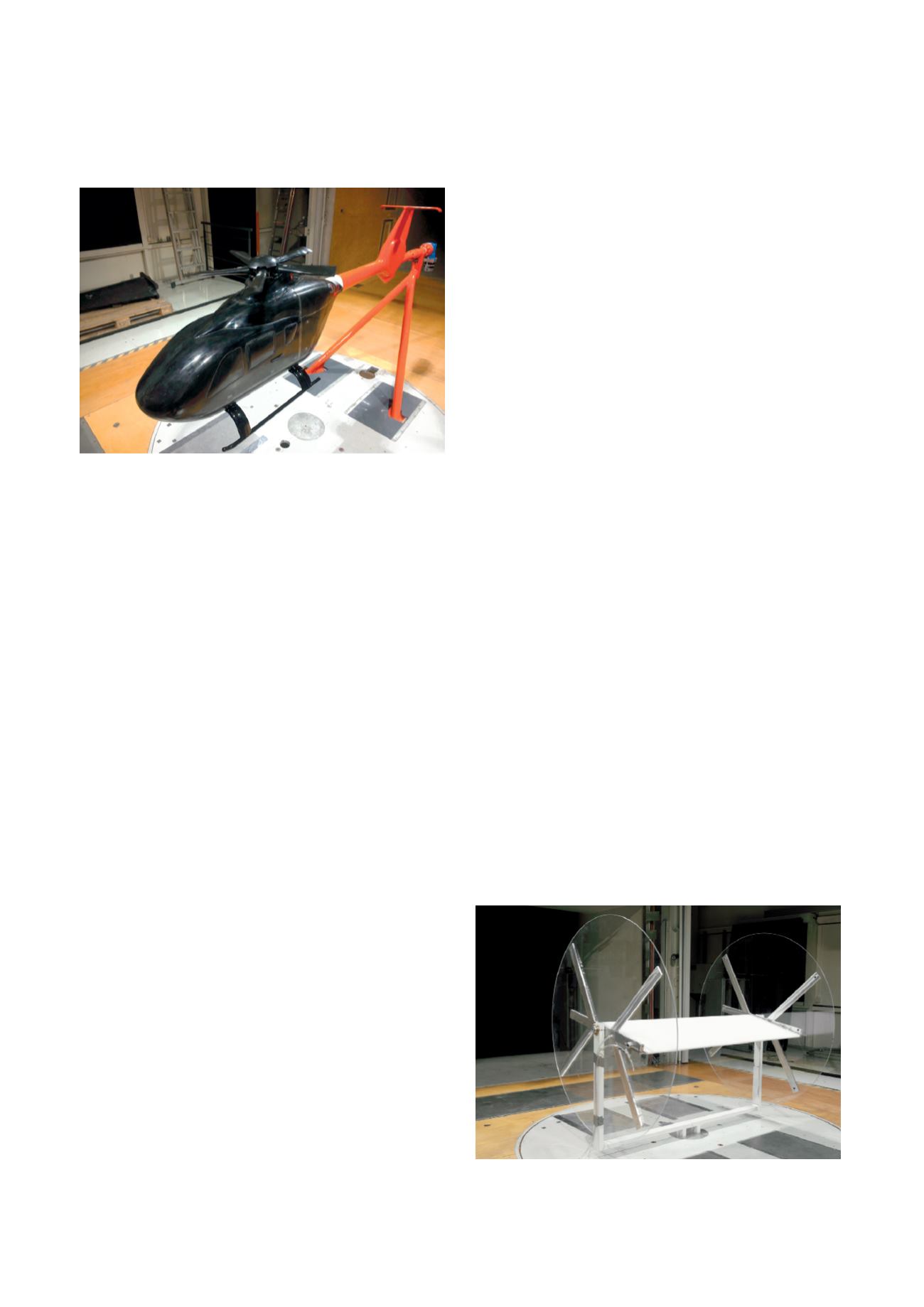
Model of BLUECOPTER configuration mounted in the test section of wind
tunnel A.
Test bed of an elasto-flexible membrane wing configuration mounted in the
test section of wind tunnel A