




 103 / 308

103
Aerodynamics and Fluid Mechanics
Numerical Modeling of Interface Networks
Motivation and Objectives
Multi-region problems can occur when the motion of
more than two immiscible fluids is to be described. In this
case the interface network, separating the different fluid
regions, evolves in time due to interactions of the different
fluids across interface segments. These interactions can
often be described by local fluid properties. Due to the
complexity of the topology, numerical modeling of the
evolution and interactions near the interface network are
long-standing challenges for the research community
Approach to Solution
We have developed a high-resolution transport formula-
tion of the regional level-set approach for an improved
prediction of the evolution of complex interface networks.
The approach thus offers a viable alternative to previous
interface-network level-set method.
Key Results
■■
High-resolution method for evolving complex interface
networks, S.C. Pan, X.Y. Hu, N.A. Adams, Computer
Physics Communication, accepted for publication 2017
■■
High-order time-marching re-initialization for regional
level-set functions. S.C. Pan, X.X. Lyu, X.Y. Hu N.A.
Adams, Journal of Computational Physics, accepted
for publication 2017
■■
Single-step re-initialization and extending algorithms
for level-setbased multi-phase flow simulations. L. Fu,
X.Y. Hu, N.A. Adams, accepted for publication 2017
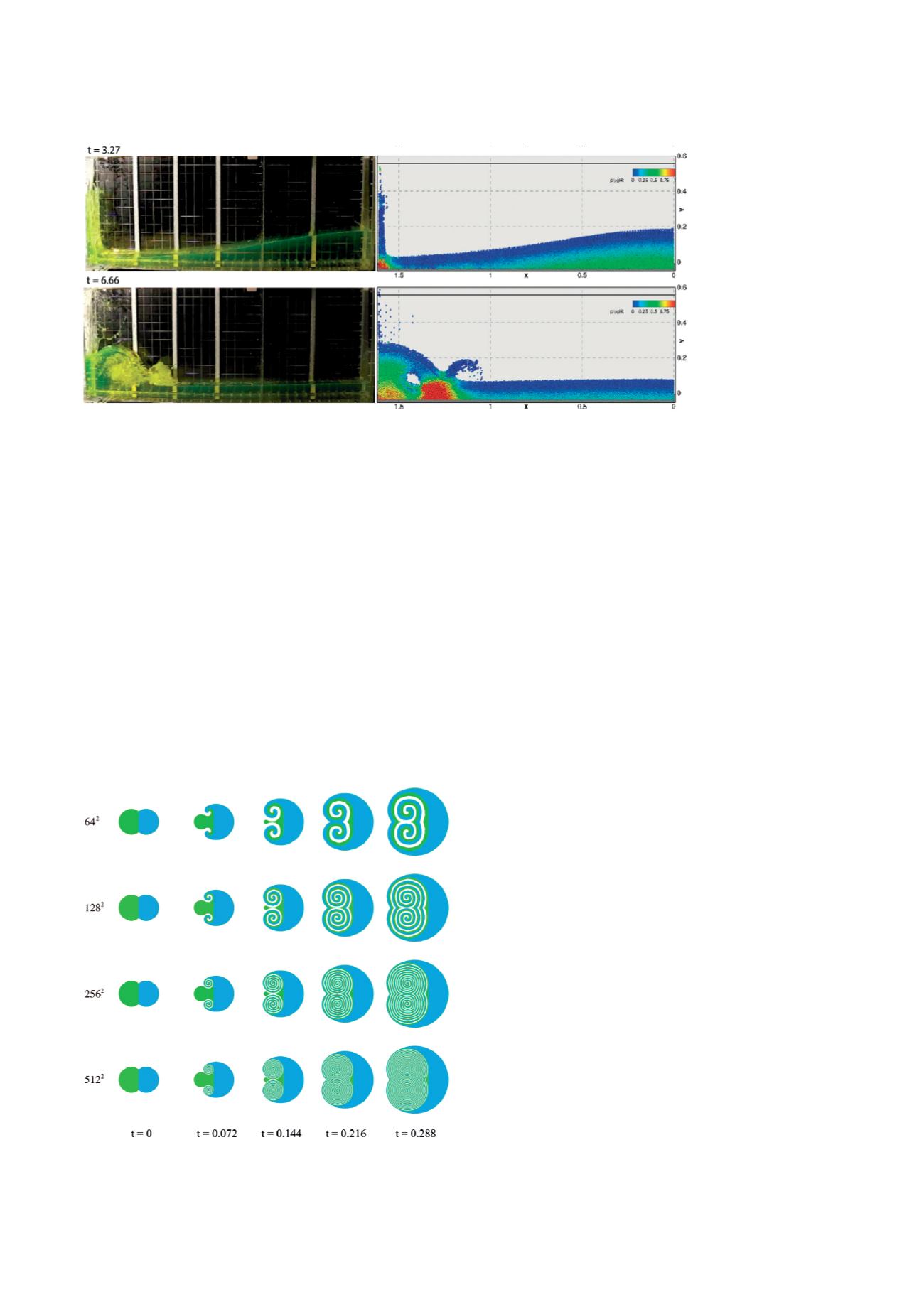
Constant normal driven flow of an interface network with three regions at
different time instance
Key Results
■■
A weakly compressible SPH method based on a
low-dissipation Riemann solver, C. Zhang, X.Y. Hu,
N.A. Adams. Journal of Computational Physics 337
(2017) 216–232.
■■
A generalized transport-velocity formulation for
smoothed particle hydrodynamics, C. Zhang, X.Y. Hu,
Three-dimensional dam-
break problem simulated
with dp =H/30 (the total
fluid particle number
N=27000): free-surface
profile compared with
experiment.
N.A. Adams. Journal of Computational Physics 337
(2017) 216–232.
■■
Targeted ENO schemes with tailored resolution
property for hyperbolic conservation laws, L. Fu, X.Y.
Hu, N.A. Adams, Journal of Computational Physics 349
(2017) 97–121.