




 134 / 308

134
Mechanics and High Performance Computing
A Multiscale Model of Atherosclerosis
A multidisciplinary approach to the mechanobiology of
atherosclerosis is taken that is based on computational
techniques and experimental calibration and verification
as well as in- and ex-vivo molecular imaging. The bio-
logical processes involved take place at the (sub)cellular
length scale and will be assessed experimentally by
histology by our project partners from Klinikum rechts der
Isar. Based on the imaged 3D geometries, macroscopic
computational fluid-solid interaction models with trans-
port, diffusion and interaction of species and cells supply
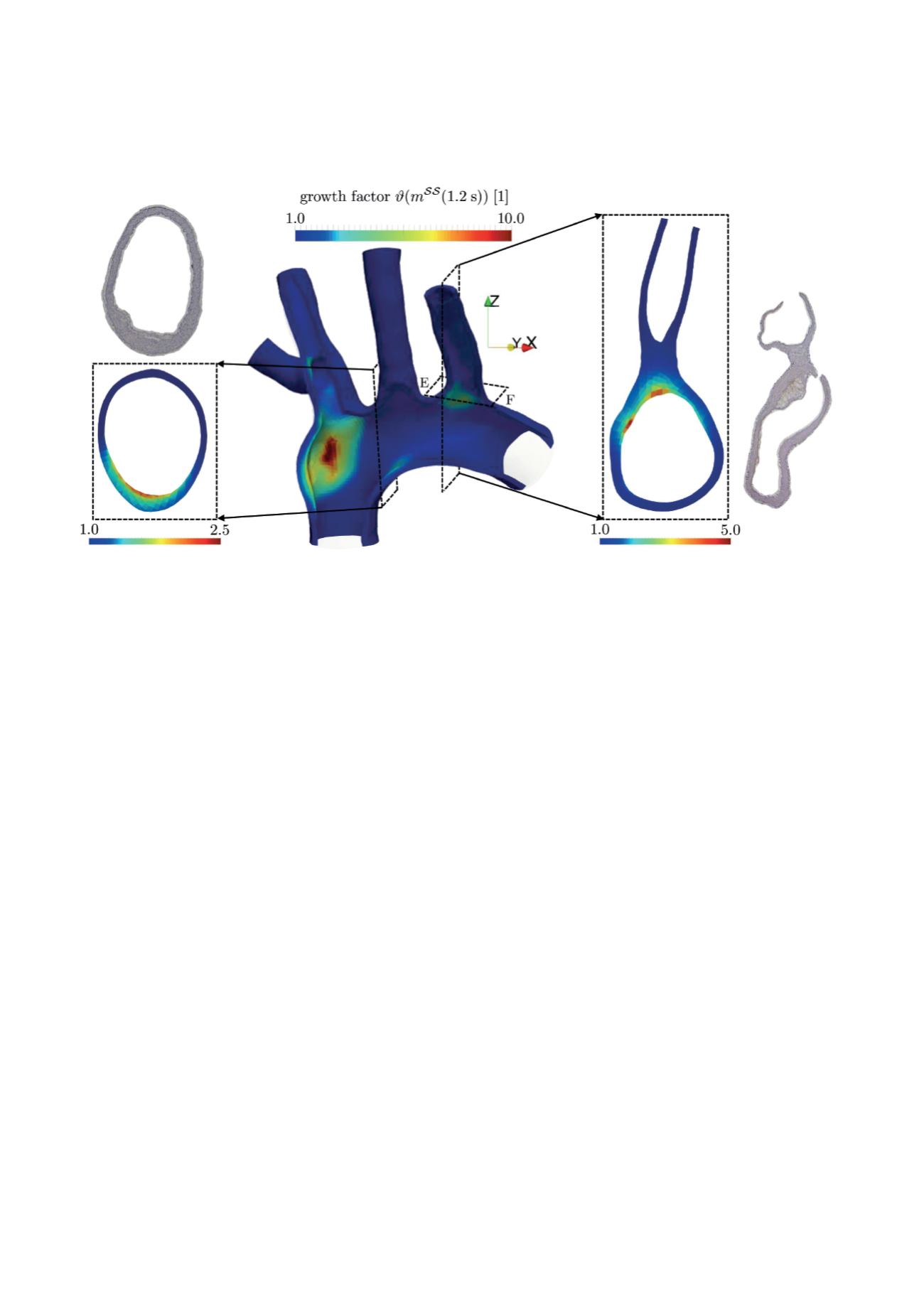
Grown artery wall, spatial distribution of relative volume increase (growth factor) and comparison of cross sections with stained aortic cross sections
from LDL receptor deficient mice with early (left top) and advanced (right) atherosclerotic plaques.
an understanding of the local mechanical conditions
which can then be correlated to the biological findings.
A computational mesoscopic biological model will be
implemented which will be coupled to the macroscopic
continuum representation of the region of interest in
a multiscale in time and space framework. Imaging of
several stenoses in mice as well as carefully designed in
vitro experiments are applied to test the hypotheses of the
model, calibrate its behavior and evaluate its predictive
capabilities.
Parametric Model Order Reduction for Large Scale Problems
Model order reduction (MOR) is a technique under current
research, which aims at a decrease of computational effort
in large-scale problems. The basic idea is to find a low
dimensional subspace for the problem’s solution, while at
the same time the quality of the solution shall be retained
in comparison to a direct solution of the large-scale
problem.
We aim at developing a MOR framework for finite element
mechanical analysis of abdominal aortic aneurysms.
The reduction shall be performed for material as well
as geometric parameters determining the mechanical
properties as well as the geometry of the aneurysms. The
intended framework faces several complexities such as
model nonlinearities, patient-specific geometries and the
guarantee of small error bounds.