




 135 / 308

135
Mechanics and High Performance Computing
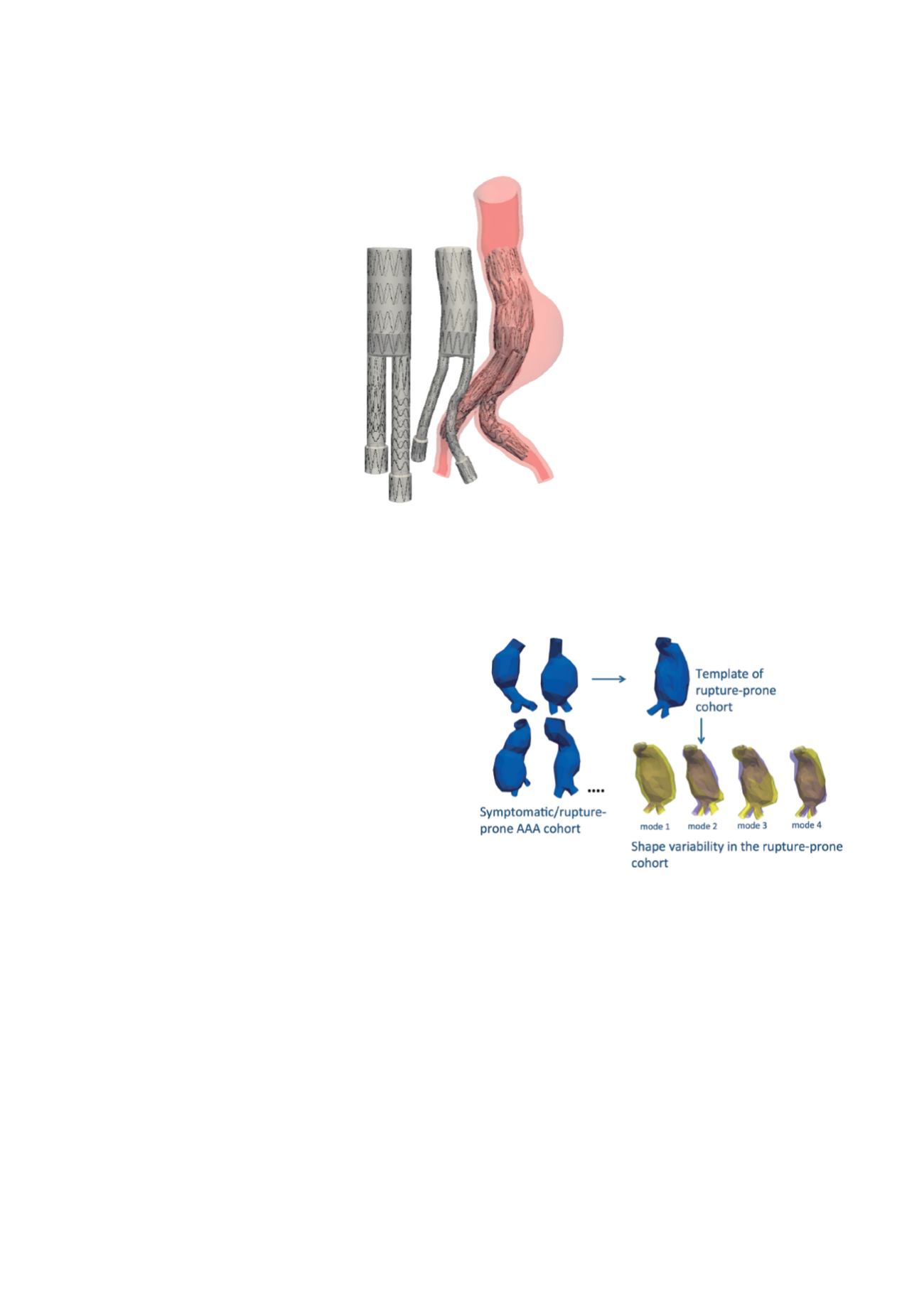
Analysis of Shape Variability of Abdominal Aortic Aneurysms
An abdominal aortic aneurysm (AAA) is a local dilation of
the abdominal aorta, leading to shapes often threatened
by rupture. In clinical practice, the classification between
stable and rupture-prone AAAs is done according to one
geometrical feature, i.e. the maximum diameter, a criterion
that is well established, but proven to be not sufficiently
accurate for rupture risk prediction. This project aims
therefore at evaluating the rupture risk based on the whole
patient-specific AAA abluminal surface. The groupwise
statistics for the classification require the estimation of an
averaged geometry, a template, of both the symptomatic/
known ruptured (rupture-prone) and asymptomatic AAA
cohort found in the exemplary database. Then, each
template is mapped to every AAA surface of both cohorts.
The mapping properties are used for the classification and
to understand the shape variability of each cohort.
Variability analysis of the symptomatic/known ruptured (rupture-prone)
AAA cohort
In Silico Endovascular Repair of Abdominal Aortic Aneurysms
Endovascular aneurysm repair (EVAR) is
a well-established technique to prevent
rupture of abdominal aortic aneurysms
(AAA). In this technology, a stent-graft
(SG) is deployed inside the AAA to
exclude the aneurysm sac from the main
blood flow. However, EVAR involves
some unfavorable complications such
as endoleaks or SG migration. Such
complications, resulting from wrong
placement of the SG or incompatibility
of SG design and AAA geometry, are
difficult to predict.
We aim at developing a predictive tool
for the selection and sizing process of
SGs depending on the patient-specific
AAA geometry. A further objective
of the predictive tool is a better risk
assessment of the intervention indicat-
ing potential SG-related complications
already in the preoperative planning
phase. The predictive, numerical tool
based on finite element analysis requires
the combination of various complex
simulation components, such as contact
mechanics between AAA and SG,
mechanobiology of AAA, morphing
strategies for the positioning of the SG
and material modeling of the superelas-
tic behavior of nitinol.
In silico stent-graft placement and
deployment