




 138 / 308

138
Non-destructive Testing
Multiscale Modeling of the Degradation Progress in the Localised
Fracture Zone of Carbon Fiber Reinforced High-performance Concrete
Subjected to High-cycle Tension and Flexural Tension Fatigue Loading
As a part of the DFG priority program ‘Cyclic deterioration
of High-Performance Concrete in an Experimental-virtual
Lab’, the study will address the degradation process
in carbon fiber reinforced concrete. Part of this work is
non-destructive damage detection and deterioration
monitoring during laboratory experiments. This task will be
achieved not only with standard non-destructive methods
like acoustic emission analysis and ultrasound transmis-
sion methods but also with coda-wave interferometry.
Concrete cylinder during compression test
Concrete Pavement Scanner
Aging infrastructure is a major topic of interest that also
applies to road networks. For targeted maintenance and
repair measures NDT tools to characterize the current
state of structural elements are highly desirable. Concrete
pavements approaching the end of their service life can
suffer from damage not visible on the surface but poten-
tially affecting safety and serviceability. Such damage
includes, for example, horizontal cracks or delaminations
within the pavement structure due to heat-induced stress
or detrimental chemical influences. Although several
non-destructive testing methods can be applied to con-
crete pavements most of the conventional techniques like
ultrasonics or ground penetrating radar have drawbacks
in imaging the above-mentioned defects. On the other
hand, testing methods based on the propagation of elastic
waves have high sensitivity to flaws like delaminations and
have potential to be applied to concrete pavements in an
automated manner. This project focuses on developing
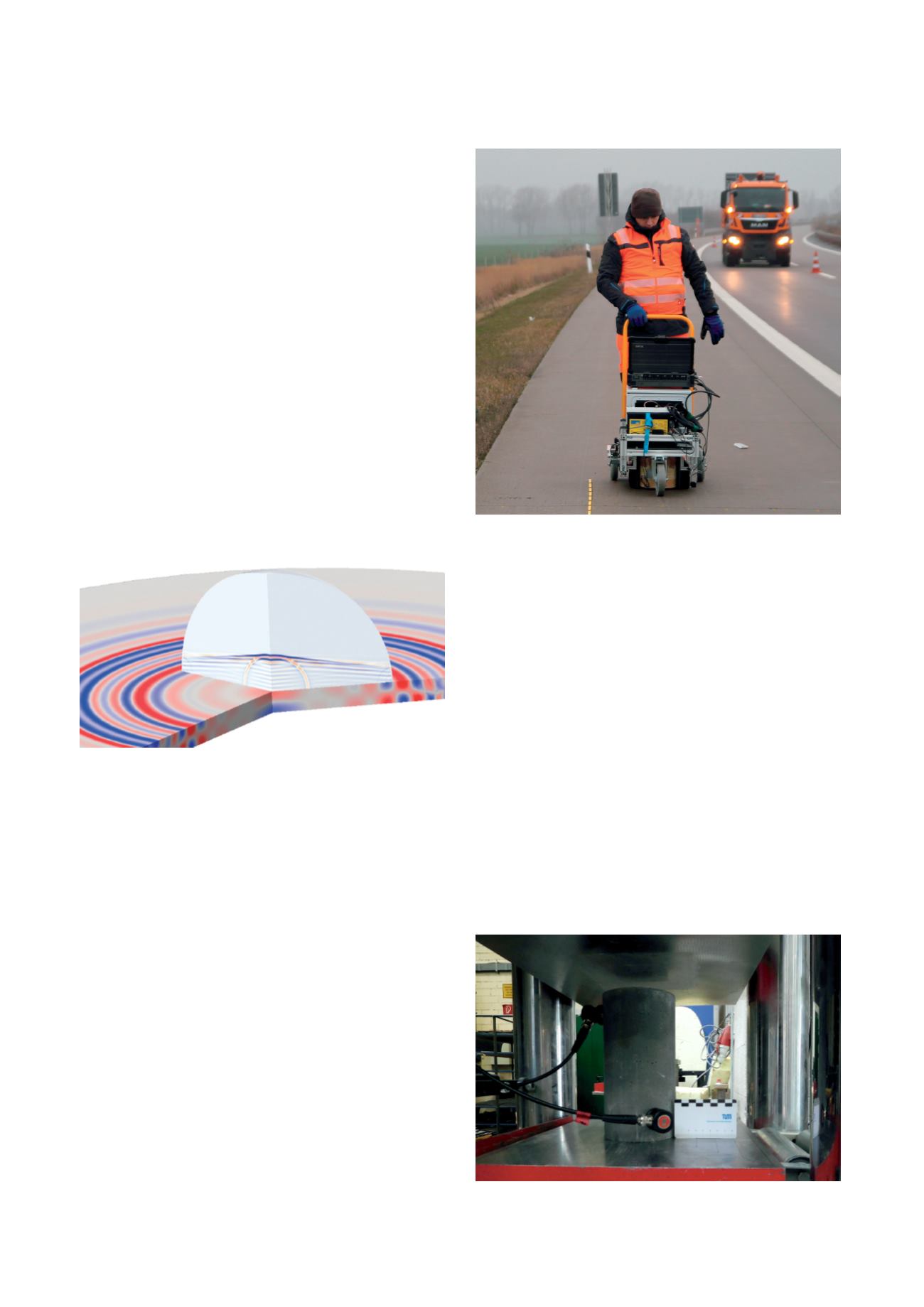
Scanner in operation on a highway
Simulation of wave field in concrete plate and radiated sound waves.
an acoustic scanning method to image relevant damage
inside concrete pavements. The approach aims to develop
a new acquisition strategy for the so-called impact-echo
method. Primary goals are the development of sensing
systems based on microphone arrays specifically tailored
to the demands of concrete pavement testing. Further,
acquisition strategies and hardware aspects for testing
entire road sections will be examined. The project is
financed by the German Federal Highway Research
Institute (BASt), under the authority of the Federal Ministry
of Transport and Digital Infrastructure (BMVI).