



 139 / 308

139
Non-destructive Testing
MISTRALWind
Within the next few years, many
established wind turbines are going to
reach the end of their nominal service
life, which is 20 years. Maintaining
and operating structural parts of
wind turbines beyond their nominal
service-life makes sense from an
economical and technical point of
view. To reach this aim, a concept
for inspection and monitoring of
structural parts of wind turbines
is developed in cooperation with
IABG, Siemens, Max Bögl Wind AG
as well as the Chair of Structural
Analysis and the Chair of Materials
Science and Testing of the Technical
University of Munich. The work of the
Institute of Non-destructive Testing is
focused on developing a long-term
monitoring system and short-term
non-destructive testing techniques
for tower and foundation of onshore
wind turbines. Both techniques
have successfully been applied to
a full size 3 MW Wind Turbine. The
results are combined and serve to
evaluate loads and the actual state
of the structure. With the aid of the
acquired data, maintenance and
servicing costs shall be optimized.
Beyond that evaluated data will be
employed as a basis for an extension
of the service life of wind turbines
and for the development of a control
strategy that considers the remaining
service life. The project is funded
by the German Federal Ministry for
Economic Affairs and Energy (BMWi).
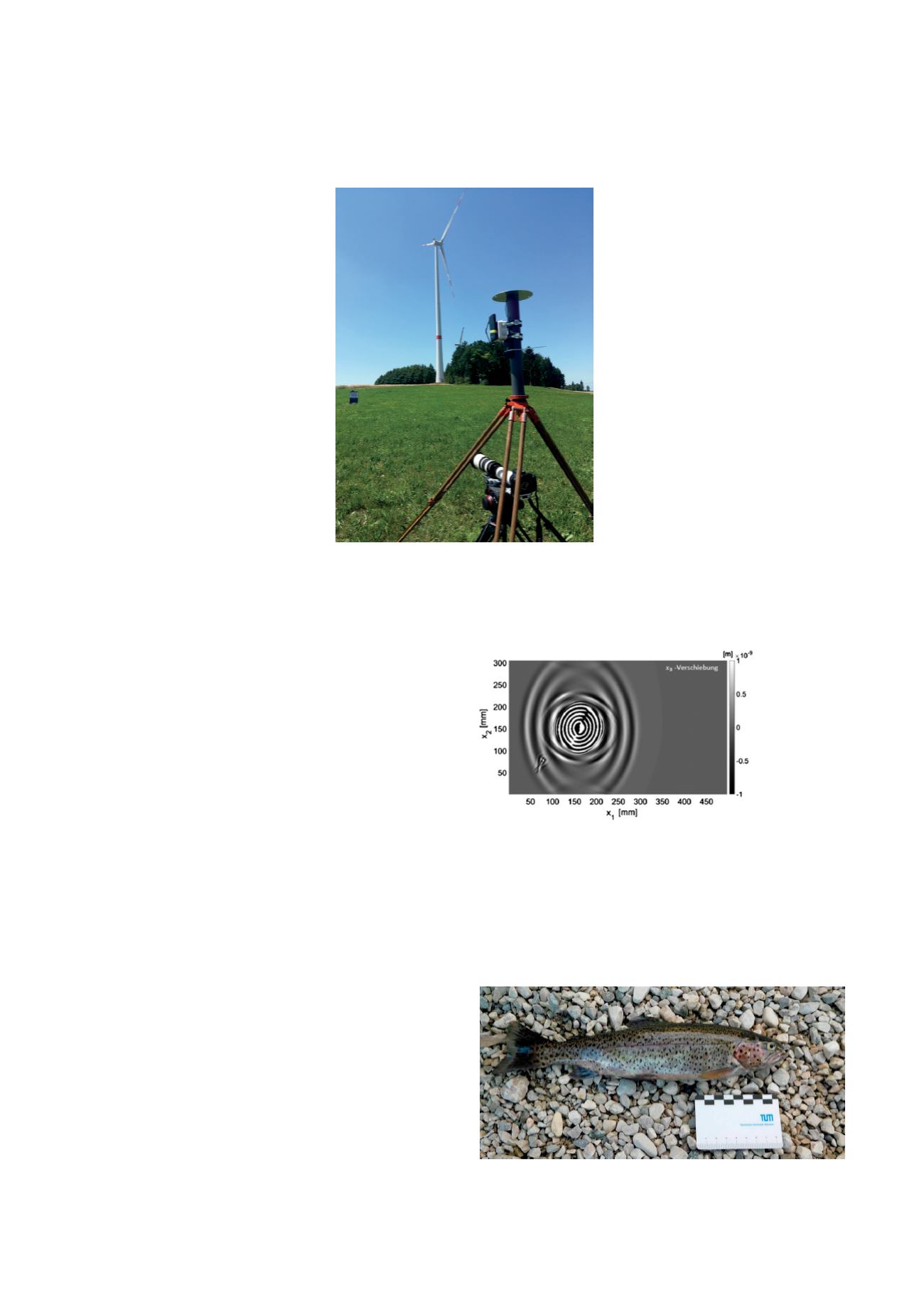
Monitored wind turbine in the Oberpfalz region
Hydro Acoustic Tracking Concept
In order to monitor the migration of fish, especially
downstream of hydro-power plants, the development of
a hydro-acoustic measurement concept is the goal of the
project. A tomographic approach is therefore necessary
to cover a finite volume of water. The built-up prototype
showed promising results during test measurements at a
model plant of the Obernach Research Institute (Chair of
Hydraulic and Water Resources Engineering).
Trout travel upstream to spawn, where hydropower facilities constitute a
major obstacle (Master thesis, R. Scharl)
Non-destructive Testing of Fiber Reinforced Composites
Fiber reinforced polymeric materials are used for light-
weight constructions and are an integral part of cars,
airplanes or rotor blades of wind turbines. Nondestructive
testing (NDT) methods play an increasing role in the
manufacturing process and the inspection during lifetime.
The selection of the best NDT technique for a certain
application depends – of course – on many factors includ-
ing the type, position and size of the defect to be detected
but also on secondary issues like accessibility, automa-
tion, testing costs, reliability and resolution to mention
only some. For this reason, the Chair of Non-destructive
Testing is working on the development of numerous NDT
techniques including full matrix capture of ultrasound in
reflection (phased-array), optical lock-in thermography,
air coupled ultrasound, lamb wave propagation and local
Simulated
Lamb waves
propagating in
a CFRP plate,
revealing a
delamination in
the bottom left
corner (Master
thesis, A. Narr)
acoustic resonance spectroscopy. In cooperation with
industrial partners, new approaches to computed tomog-
raphy are developed as well. In order to complete the
picture of the processes during testing, numerical simu-
lations using the Finite Element Method are conducted
alongside the experimental work.