




 223 / 308

223
Applied Mechanics
Experimental Dynamics
Dynamic testing is regularly performed in our lab to
validate models and test constructions. In addition,
experimental dynamic techniques are part of our research
aiming at improving the quality of the identification in real
conditions. As an example, a self-tracking laser Doppler
vibrometer system is under development to perform
in-operation monitoring and new laser measurement tech-
niques are tested for the characterization of biomaterial.
The research on experimental substructuring deals with
specific assembly techniques, which can be used to build
up full models based on the measured dynamics of real
components. The methods of dynamic substructuring and
transfer path analysis provide a promising combination
for the development of optimally tuned structural and
vibro-acoustical systems, using both measured and mod-
eled components. Current research involves better models
for the interface dynamics between parts and numerical
design optimization for lower overall sound transmission.
Substructuring methods are also used in so-called real-
time hybrid testing. This special hardware-in-the-loop
technique numerically simulates structural components for
which models are available, and exchanges in real-time
forces and displacements on the interfaces with a real
hardware component in the lab. Furthermore, different
numerical and experimental methods are investigated on
a wind turbine in an experimental dynamics lab. Modal
analysis techniques are applied to improve substructuring
and model order reduction techniques.
The research field of rotor dynamics includes techniques
to characterize the rotor dynamics as well as the dynamic
behavior of seals and bearings. Reduced component
models are set up and validated on several test rigs in the
experimental dynamics lab. In this way, influences such as
seal instabilities and bearing effects on rotor systems can
be determined. Furthermore, active magnetic bearings are
investigated with a focus on the modeling and experimen-
tal validation of the nonlinear magnetic behavior.
Model-based monitoring, fault detection and control is
another research interest of the chair. To account for aging
effects in common rail diesel injectors that can appear
over the lifetime of an engine, model-based identification
and control methods have been developed in cooperation
with the Chair of Internal Combustion Engines. Numerical
and experimental results show the great potential in
improving long-term engine efficiency and controlling
exhaust emissions. Besides, the chair explores new
monitoring approaches for rotating machinery using
accelerometers built of micro-electro-mechanical systems
(MEMS) in a sensor network for fault prediction. Thereby,
combinations of signal- and model-based algorithms
are implemented on sensor nodes and verified on real
machines.
Projects
■■
Real-time substructuring for complex systems (internal)
■■
Substructuring methodology for transfer path analysis
(BMW)
■■
Rotor dynamics for turbo pumps in space propulsion
systems (BaySt-MWMET)
■■
Rotor dynamics with active magnetic bearings (internal)
■■
Modeling of common rail injectors for faults detection
and control (DFG)
■■
Interface dynamics identification in bladed disks
(EXPERTISE)
■■
Model reduction and experimental substructuring (Ira-
nian Ministry of Research, Education and Technology)
■■
In-operational measurement on a wind turbine test
bench (Chinese Scholarship Council)
■■
Mechanical monitoring with MEMS sensor network
(Siemens)
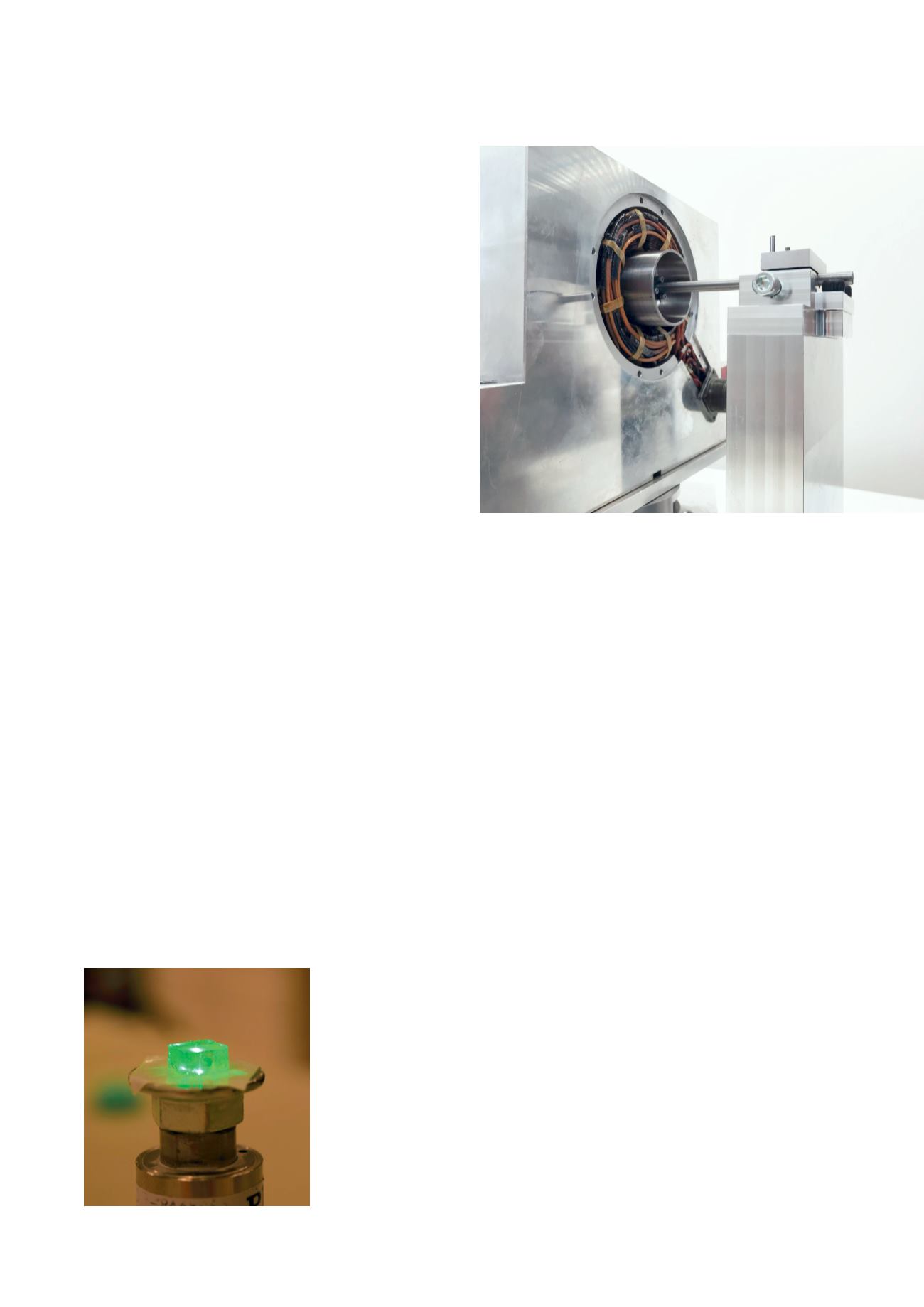
Special test rig for magnetic bearings to measure forces in all six dofs
Hydrogel sample (5 mm
x 5 mm x 3 mm) fixed on
a piezo stack during a
laser-Doppler vibrometry
measurement