



 224 / 308

224
Applied Mechanics
Robotics and Mechatronics
The chair has a long tradition in designing, constructing
and controlling robots for novel applications. Based on the
expertise in autonomous legged robots, the institute has
developed a high-performance humanoid robot (LOLA) in
recent years.
Autonomous navigation of mobile robots in cluttered
environments is a difficult task. Especially, if biped robots
are considered, for which continuous high-level paths
must be planned alongside discrete footstep locations in
the lower-level planning stage. New algorithms have been
developed to allow the robot to navigate autonomously
through previously unknown environments. The ability to
step over small obstacles while avoiding big obstacles
shows the superiority of this approach.
To avoid robot-obstacle collisions in a dynamic envi-
ronment, real-time perception methods for detecting
possible obstacles are investigated. Herein the focus lies
on locating objects and approximating them by geometric
primitives, so called Swept Sphere Volumes (SSV), which
allow efficient distance calculations to meet the real-time
requirements.
Furthermore, new techniques for planning and controlling
robot locomotion in the multi-contact setting, i.e. using the
arms of a humanoid robot, are investigated. Aside from
reduced models approximating the dynamics of the robot
for real-time control, various methods for perceiving the
environment and extracting appropriate support areas are
developed.
To enable robots to sense their environment and evaluate
contact properties, a flexible tactile sensor design has
been developed at the chair. In contrast to conventional
force sensors, tactile sensors allow the measurement of
the contact geometry and not only the resultant forces
on an object. This low-cost design is based on a piezo
resistive polymer.
In addition to the development of humanoid robots, the
research group also investigates methods for motion
cueing, which mainly targets driving simulators in the
automotive industry. Due to the high requirements on the
simulator’s dynamics, parallel robots are used whose spe-
cial kinematics must be considered. The research focuses
on the perceived dynamical motion from the driver’s
perspective. In recent years, the mechanical structure of
driving simulators has been becoming more complex, thus
a global optimization scheme was developed to distribute
the redundant degrees of freedom of the motion system.
We also cooperate with the Department of Orthopedics
and Sports Orthopedics, to investigate the application of
robotic manipulators to investigate the range of movement
of human joints. We investigate compliant motion control
to explore the motion space without overstressing the
tested joint.
Projects
■■
Real-time planning for flexible and robust walking of a
humanoid robot (DFG)
■■
Gait control of a humanoid robot in uneven terrain
(DAAD)
■■
Multi-contact planning and control of biped walking
robots (internal)
■■
Tactile feedback and force control of biped walking
robots (internal)
■■
High-precision control of flexible robot systems
(internal)
■■
Model predictive and filter-based control strategies for
motion cueing algorithms (BMW)
■■
Identification and control in robot-driven joint bio-
mechanics (Department of Orthopedics and Sports
Orthopedics)
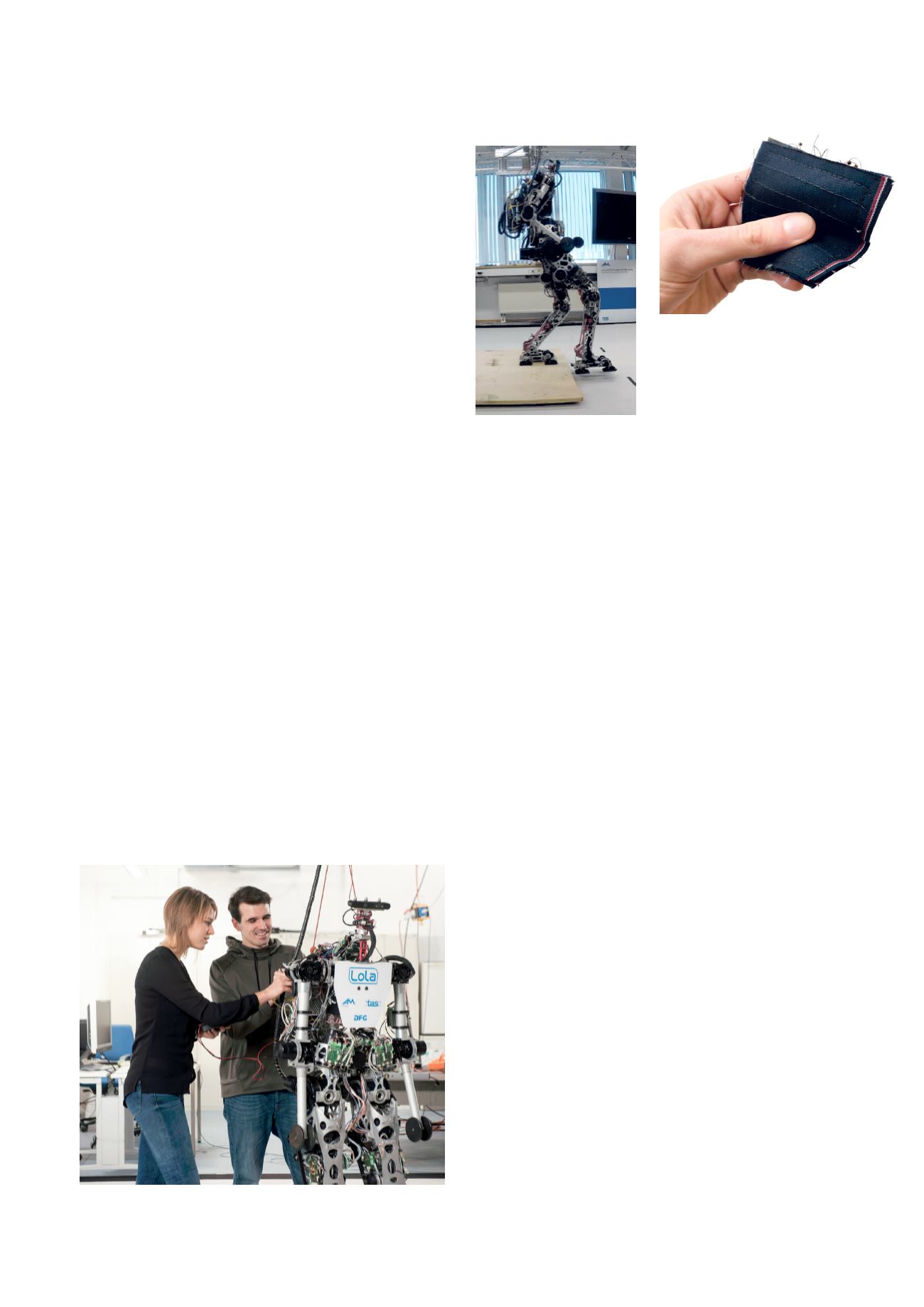
The humanoid LOLA stepping from an undetected platform of 5.5 cm
height. Based on newly developed force-control schemes, the robot is
now able to deal with such late-contact scenarios.
Prototype of a new flexible and
low-cost tactile sensor design, which
allows the measurement of external
pressure and its distribution on the
sensor area.
The humanoid robot LOLA