




 228 / 308

228
Thermodynamics
a small number of ignited sprays and consequently leads to
longer combustion durations. Furthermore, the experiments
confirm that the natural gas of the background mixture
influences the autoignition of the diesel pilot oil.
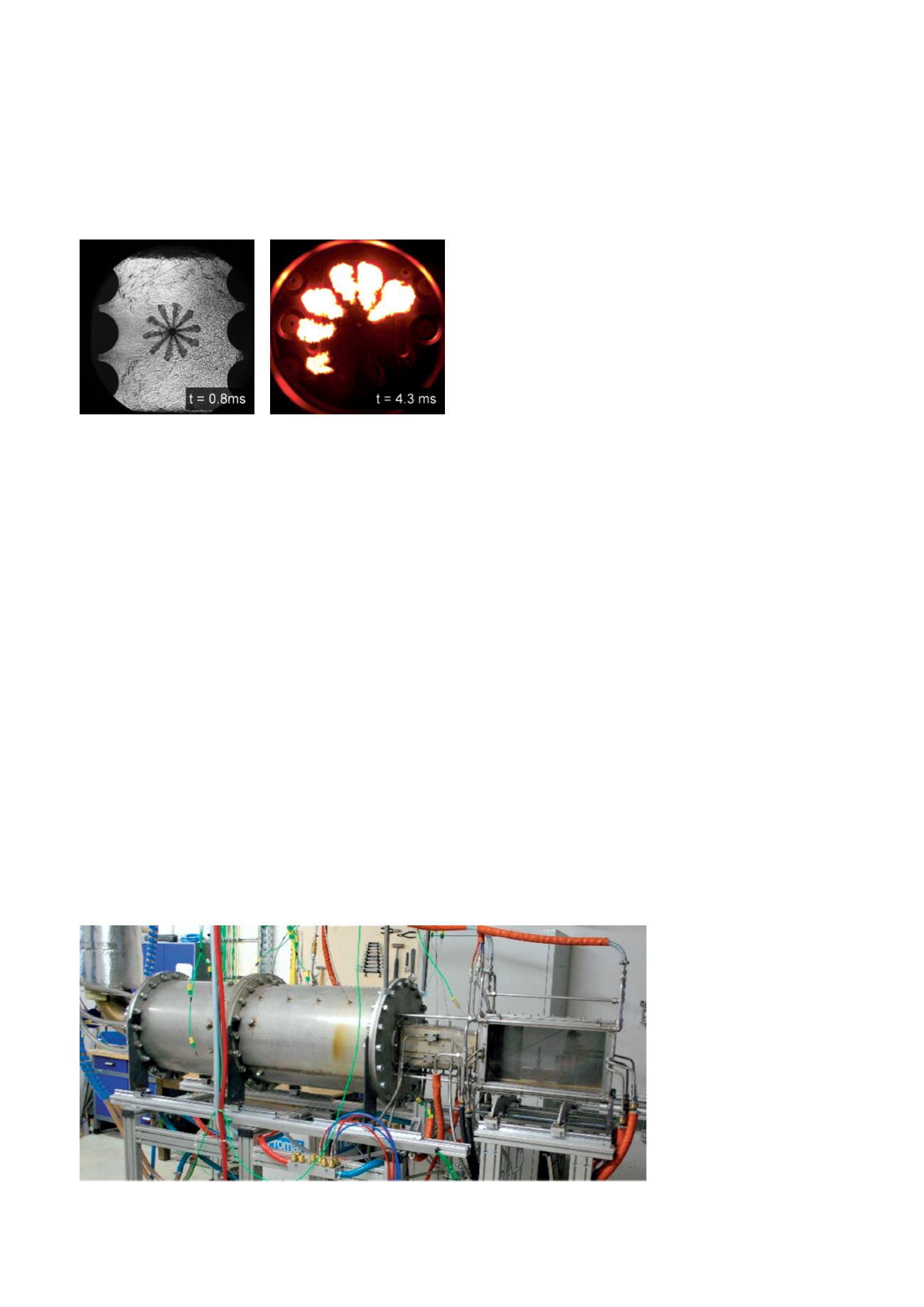
Shadowgraph image of diesel pilot injection and flame luminescence of
combustion
Numerical Investigations
The effect of fuel substitution on the ignition probability
of the resulting fuel blend was studied using detailed
reaction mechanisms. An auto-ignition model capable
of handling mixtures of two fuel types with significantly
different reactivity was developed and successfully imple-
mented in a commercial CFD software package. With
these tools ignition and heat release in dual-fuel diesel
engines are investigated for the two cases of homogene-
ous charge and high pressure direct injection of gaseous
fuel. Detailed kinetics simulations in homogenous reactors
revealed the thermodynamic conditions responsible for
the significant NO-NO
2
conversion observed in these
engines. High emissions of NO
2
were shown to be caused
by small amounts of unburned hydrocarbons which origi-
nate from flame quenching in the lean methane-air charge,
which reacting with NO during the expansion stroke and in
the exhaust system.
Related Projects
■■
Optimization of Diesel Pilot Ignition in Dual-Fuel
Engines with High Mean Effective Pressures
■■
Investigation of Direct Injection Dual-Fuel Combustion
with Flexible Fuel Combinations
■■
Numerical Simulation of NO to NO2 Conversion in Dual
Fuel Engine
Combustion Instabilities and Noise
1. High-Frequency Transversal Thermoacoustics
Motivation and Objectives
High-frequency thermoacoustic instabilities in gas turbine
combustion chambers result from constructive interfer-
ences between combustion heat release and acoustic
oscillations. They physically manifest themselves as
high-amplitude, self-sustained pressure pulsations in
the combustion chamber. Potential consequences range
from hardware damage, increased pollutant production to
system failure. Avoiding these instabilities requires a thor-
ough understanding of the physical mechanisms, for the
development of prediction models and mitigation tools.
Research activities in recent years were focused on swirl
stabilized combustion systems and allowed a deep insight
to be gained into the high-frequency thermoacoustic
Two-stage, reheat combustor experiment for the investigation of high-frequency thermoacoustic instabilities
The investigation of natural gas high pressure direct injec-
tion combustion with diesel spray piloting was performed
on a rapid compression machine. The variation of spatial
and temporal overlap of the pilot spray and gas jet shows
how the ignition behavior is governed by the interaction
between the two jets. In both experiments, high speed
imaging of flame luminescence and of shadowgraphy were
applied.