




 229 / 308

229
Thermodynamics
feedback mechanisms, both experimentally and numeri-
cally. To further develop a comprehensive understanding
of physical flame response mechanisms to high-frequency
pressure pulsations, the focus is extended towards reheat
combustion systems, which represent a highly relevant
technology for modern gas turbine systems for electrical
power generation.
Methods and Approaches
A state-of-the-art test rig for investigation of reheat flame
dynamics has been designed, commissioned and experi-
ments on the reheat flame response were conducted. The
experiment features a special design that promotes the
first transverse acoustic resonant mode, while simultane-
ously allowing the establishment of a characteristic reheat
flame with areas dominantly stabilized by auto-ignition
processes. The institute’s acoustic prediction tools, know-
how and methodologies were employed in an iterative
design process to implement an experiment that allows
for both in-depth academic studies by applying respective
acoustic and flame diagnostic measurement techniques
whilst reproducing characteristic flame features at lab
scale. This experiment is the basis of future investigations
to gain insight into distributed source terms that capture
the underlying physics of high-frequency reheat flame
response.
2. Annular Combustor Damping
Motivation and Objectives
A major concern in modern industrial gas turbines is the
occurrence of combustion instabilities. Annular com-
bustors burning under lean conditions are susceptible
to self-sustained azimuthal oscillations. A widely used
countermeasure is the use of passive damping devices
to suppress high amplitude pressure pulsations. Efficient
dissipation of acoustic energy by such resonators and
hence the disruption of the thermoacoustic feedback
cycle, requires appropriate dimensioning and an effective
placement strategy especially in the case of annular
combustors.
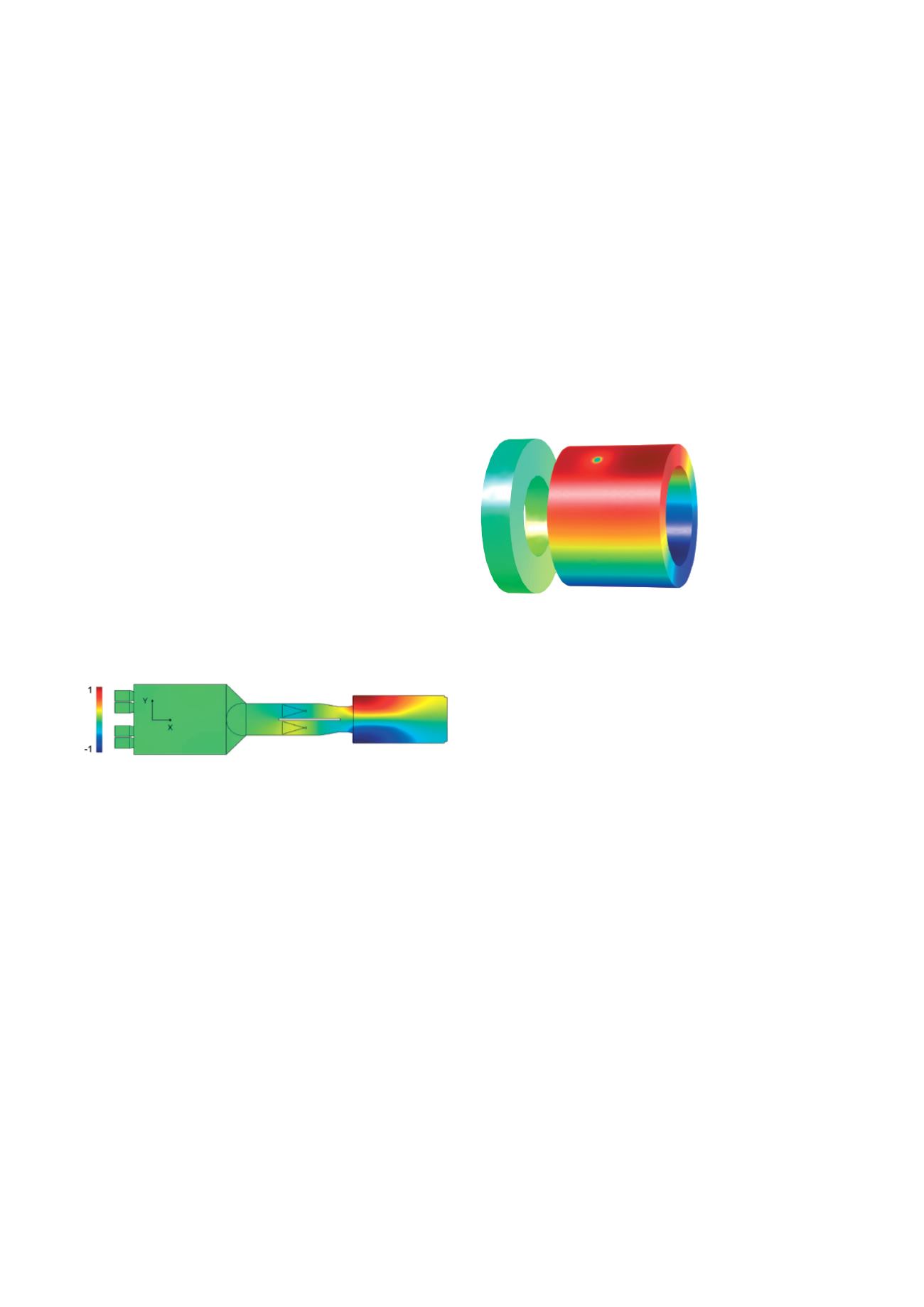
Normalized acoustic pressure distribution within the two-stage combustion
rig from frequency domain simulations
Key Results
The novel reheat combustor experiment represents real-
istic reheat flame features as found in industrial systems
and allows for an extensive scope of investigations. The
specific combustor design of the rig has been optimized
simulating its thermomechanical and fluid dynamic char-
acteristics. The acoustic design, sought to predominantly
excite the first transverse mode, is developed by means
of analytic approaches together with computational
aero-acoustics in the frequency domain. In addition to
this, a priori linear stability assessments are carried out
to maximize the flame-acoustics constructive feedback.
This rig design was successfully commissioned and is
now used to conduct investigations to establish insights
into the physics of reheat flame dynamics and to provide
validation data for the development of analytical and
numerical prediction models for thermoacoustic stability
assessment tools as well.
Instantaneous
pressure distribution
in the annular
combustor test rig
with two damper
impedances applied
Experimental Approach
Different damper configurations with respect to the
number of dampers, their spatial distribution and the
amount of purge air are investigated and compared to the
baseline case without dampers. To assess the stability
quantitatively three methods for damping rate computa-
tion from dynamic pressure data have been developed:
The first method is based on the analysis of the decay
of the pulsating pressures after sudden shut-down of
sirens providing single frequency acoustic excitation. The
second method employs so-called Lorentzian fitting to
the pressure spectra resulting from turbulent combustion
noise and the third method consists of the analysis of the
autocorrelation of the acoustic pressures.
Numerical Approach
The measured damping rates serve as a validation data-
base for a numerical methodology based on the linearized
Euler equations to predict the stability margin of the rig
quantitatively in a wide operating range, and to assess
the influence of different damper configurations and
fuel-stagings on the thermoacoustic stability to deduce
basic guidelines for the application of passive damping
concepts in annular combustors.
Related Projects
In a similar project, the application of the damping
devices in a can-combustor is investigated in high
frequency regime. To avoid high-frequency vibrations,