




 230 / 308

230
Thermodynamics
destruction of the engine and thus mission failure. The
prediction of these instabilities and the assessment of
counter measures is the objective of this project, to
support the reliable design of thermo-acoustically stable
rocket engines.
Methods and Approaches
Numerical simulations are carried out in the frequency
domain. Eigensolutions of linearized Euler equations are
computed, describing modes and frequencies of the
acoustic oscillations in the combustor. Absorbers are
accounted for by impedance boundary conditions and
a dome can be coupled to the chamber via a transfer
matrix. Source terms in the energy equation account for
flame feedback. Experimentally, studies are carried out on
a cold-flow rocket engine configuration.
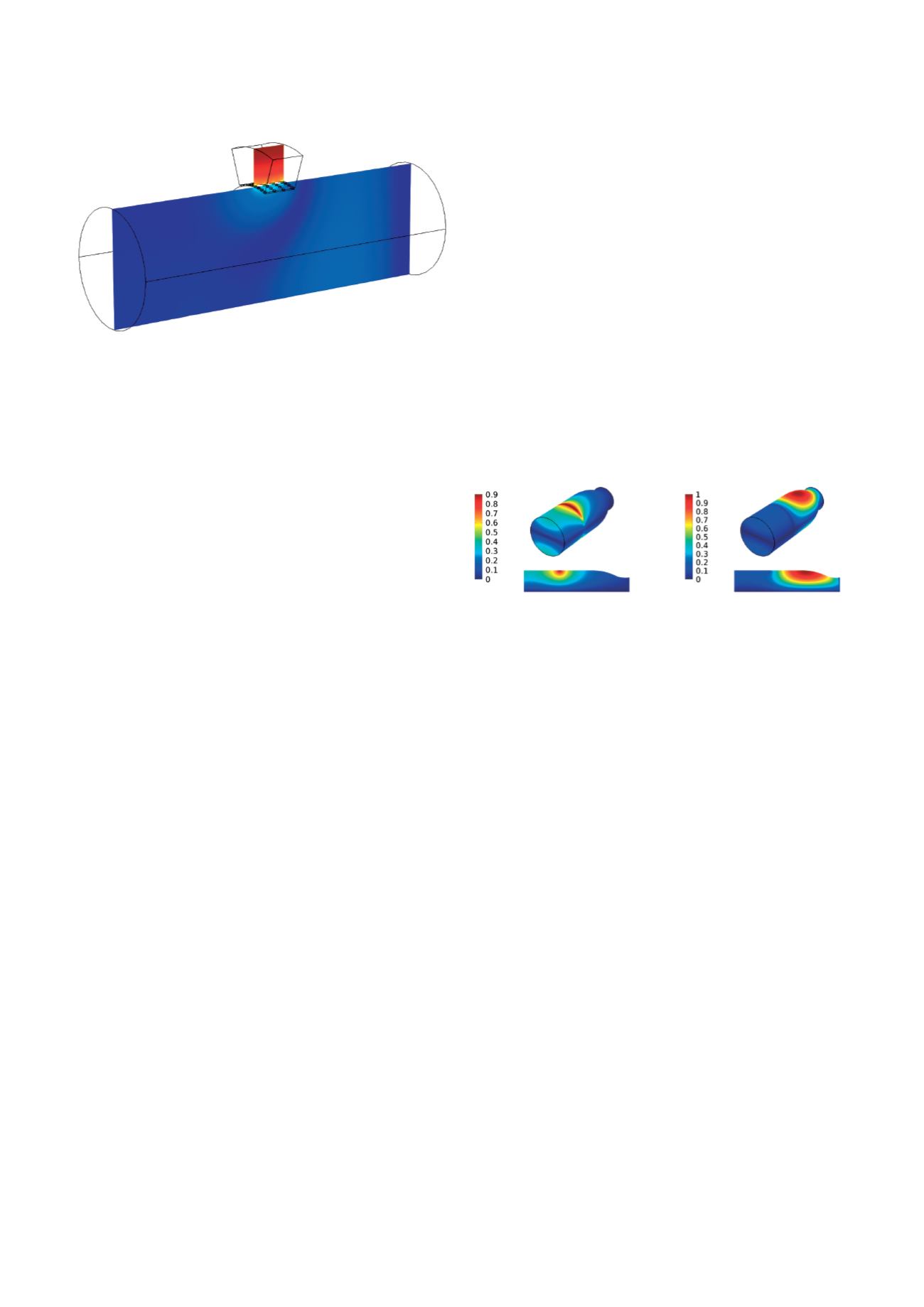
Normalized pressure amplitudes of the split modes occurring upon
application of an absorber ring; from: Kings et al.
Transport Phenomena
1. Behavior of the Void Fraction in Subcooled
Flow Boiling Close to Critical Heat Flux
Motivation and Objectives
In nuclear engineering the heat transfer in both reactor
core and steam generator are of great interest regarding
the safe operation of a nuclear power plant. Beyond a
critical value of the heat flux (CHF), film boiling can occur.
This boiling crisis and the departure from nucleate boiling
must be avoided under all circumstances.
Approach to Solution
The experimental work conducted at TUM is aimed at
providing detailed experimental data about CHF condi-
Instantaneous pressure distribution in a single damper configuration
(CFD/LNSE method)
the increase in the acoustic damping of the combustion
chamber is of central importance. This requires precise
modeling tools which are not yet state of the art. There-
fore, the purpose of this project is to develop a hybrid
method for the damping calculation of can combustion
chambers used in the high efficiency machines. This
includes a combination of non-linear and linear field
methods with network methods and the aim of creating
a hybrid process that is as efficient as possible. In this
context, two methods are introduced. The first approach
is the CFD/LNSE method, where the modeling task is
to calculate the acoustic processes in the combustion
chamber (basket and transition) based on linearized
Navier-Stokes equations (LNSE). In the other approach,
perturbed non-linear non-conservative Euler (PENNE)
equations will be implemented for computational aero
acoustic (CAA) simulations. In general, the hybrid
approach, separating the calculation of mean flow field
and perturbation in time domain will help to identify the
acoustic behavior of combustion chambers and associ-
ated damping elements at comparatively low cost.
3. Combustion Instabilities in Rocket Engines
Motivation and Objectives
High frequency combustion instabilities arise from the
interaction of field fluctuations due to the combustor
acoustics with the heat release from the combustion.
Consequences of unstable operation can reach up to
Key Results
For the stability predictions in rocket combustors, analysis
has been extended to different propellant combinations.
The modes in a hydrogen and a methane fueled engine
without flame feedback have been compared with each
other. Computational and qualitative differences in the
cut-on behavior have been observed. In contrast to H
2
,
for CH
4
higher modes can be cut on in the front chamber
part, before lower modes are cut on at the rear end.
Further numerical and experimental studies have been
continued examining the modification of chamber acous-
tics by the application of an absorber ring. The mode split
observed previously has been studied with respect to the
absorber design and a significant influence on the mode
shape as well as eigenfrequencies has been found.