



 26 / 308

26
The History of the Department
2011
The department is the first institution at TUM to be
evaluated. The assessors confirm its outstanding
research results. During the following years the
department succeeds in considerably enhancing its
scientific profile.
Under the project management of Markus Lienkamp,
TUM presents the MUTE at the IAA Motor Show for
the first time – a joint project by 20 departmental
professorships. The MUTE is solely electrically-pow-
ered. It has a maximum speed of 120 km/h and a
minimum range of 100 kilometres.
2014
The eLi14 is a vehicle designed by the TUFast
student group. It sets the Guinness world record as
‘Most Efficient Electric Vehicle’.
2015
Nikolaus Adams wins the ERC Advanced Grant
‘NANOSHOCK – Manufacturing Shock Interactions
for Innovative Nanoscale Processes’. This research
project examines which mechanisms and properties
enable the controlled formation of shocks in very
complex environments – such as living organisms.
These questions are to be studied and answered
with the help of modern computer simulation models
and some carefully selected experiments.
2016
Travelling from one place to another at almost the
speed of sound – that is the idea behind the‘Hyper-
loop Pod Competition’ of visionary Elon Musk. Out
of initially 700 teams, 30 teams are selected to build
a prototype at the end. The WARR study group at
the Department of Mechanical Engineering at TUM is
one of these teams. In August 2017, the team wins
the maximum speed competition with its Hyperloop
Pod II and establishes a new speed record with 324
km/h.
In 2015, Cevotec, a spin-off from the Technische
Universität Munich, is set up by scientists of the
Chair of Carbon Composites at the Department of
Mechanical Engineering and wins the important
start-up competition ‘Weconomy’ in 2016. The
Cevotec founders develop a fully automated manu-
facturing method that not only makes the production
of carbon parts more efficient but also reduces the
amount of material required.
2016
A new helmet-mounted sighting instrument
developed by scientists at the Chair of Helicopter
Technology is introduced. The ‘augmented reality’
device enables helicopter operations in poor
visibility, increasing the safety of both pilots and any
passengers on board.
2017
The department sets up its first cross-chair cluster
‘Additive Manufacturing’. In addition to investments
made by the chairs involved, the department
contributes more than €500.000 in start-up aid to
establish this pioneering topic.
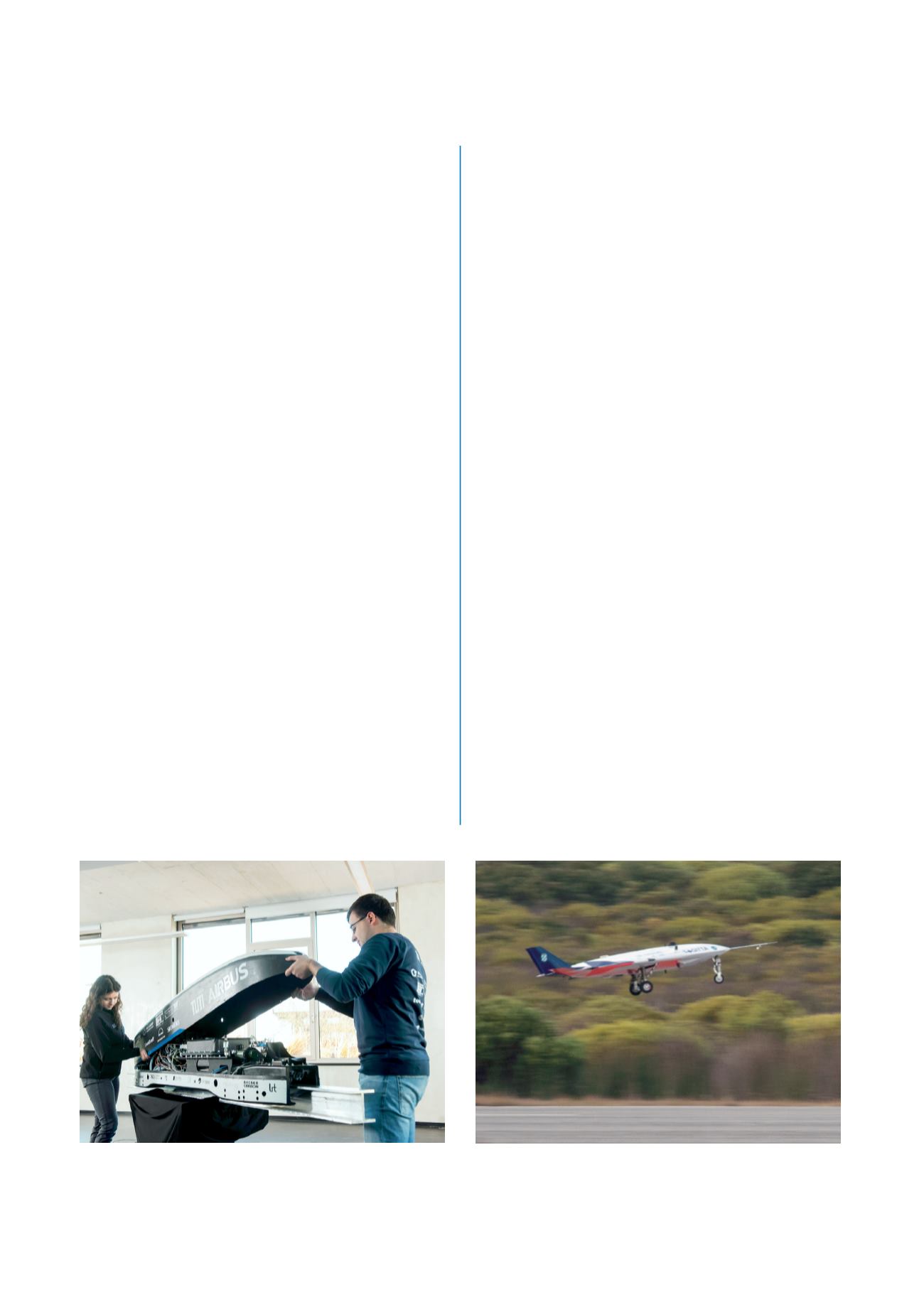
Successful maiden flight of the Sagitta unmanned
flying wing. Other participants in this ‘open inno-
vation initiative’ by aircraft manufacturer Airbus,
besides TUM, are research institutes of the German
Aerospace Centre DLR, the Universität der Bundes
wehr in Munich, the Technical University in Ingol-
stadt and the TU Chemnitz.
2018
After enhancing the department’s scientific profile
following its evaluation in 2011, the department has
consistently maintained top level positions in major
international research rankings; no. 1 in Gemany in
both the Times Higher Education Ranking and the
NTU Ranking – continuously among the Top 10 in
Europe and the Top 40 worldwide.
SAGITTA unmanned demonstrator
Students of the WARR Hyperloop team