



 192 / 308

192
Micro Technology and Medical Device Technology
Additive Manufacturing Technologies
Arburg Freeformer
Laparoscopic partial nephrectomy allows the surgical
resection of kidney tumors with the aim of partially
preserving kidney function. For intraoperative imaging a
laparoscope is used, which allows only superficial imaging
of the abdominal cavity. Additionally, a laparoscopic
ultrasound probe can be used to gain information about
the subsurface of the organ in order to determine the
resection line for the removal of the tumor. Usually, images
from the laparoscope and the ultrasound system are
displayed on separate screens. Matching information from
both imaging sources to the anatomical context in the
mind is challenging and error-prone.
The aim of this project, which is funded by the German
Research Foundation (Deutsche Forschungsgemein-
schaft), is to improve laparoscopic partial nephrectomy
in the field of intraoperative imaging and visualization of
information by integrating augmented reality features by
superimposing additional information gained with the
ultrasound probe onto the laparoscopic image.
Augmented Reality in Laparoscopic Partial Nephrectomy
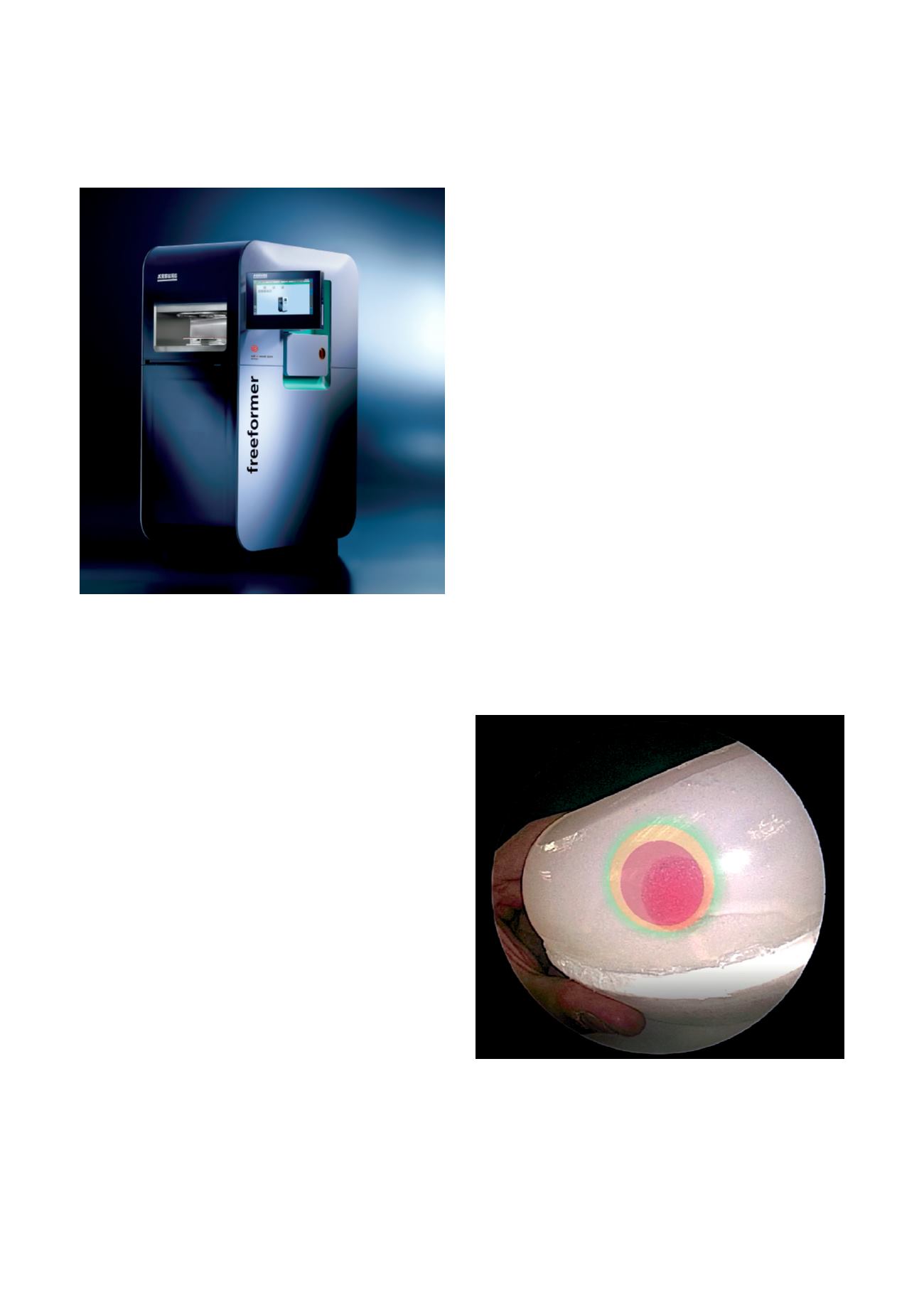
First realization of the augmented reality feature in a model by super
imposing the contour of a tumor and a safety margin onto the surface
of the organ (MiMed).
The claim in additive manufacturing changes more and
more from just generating prototypes for demonstrating
issues to producing final functional parts. This increases
the requirements concerning the freedom of material,
dimensional accuracy and component properties.
In 2013, after a collaboration with our institute, Arburg
GmbH introduced Arburg plastic freeforming (APF) as
a novel droplet-based additive manufacturing method.
Using conventional thermoplastic polymers, the Arburg
Freeformer expands the freedom of manufacturing. In
earlier collaborations, our institute took part in designing
the droplet generator and the data preprocessing.
Current research concentrates on investigating in the
achievable component properties and introducing new
materials for the manufacturing process. Furthermore,
material parameters and dimensional accuracy of the
manufactured parts should be optimized systematicall.
Therefore, new building strategies are developed to
influence the temperature distribution during the manu
facturing process. This way unwanted effects like curling
can be reduced and dimensional accuracy can be
improved.